

Is kWh an SI Unit? The Definitive Engineering Guide & Calculation Formulas
Bridging the gap between theoretical physics and your electricity bill: A deep dive into Joules, Watts, and Energy Measurement.
1. The Conflict Between Physics and Billing
EXECUTIVE SUMMARY
While the Kilowatt-hour (kWh) is the universal standard for billing electrical energy, it is NOT an SI Unit. The official SI unit for energy is the Joule (J). This guide explains why the world uses kWh, how to derive the conversion ($1 \text{ kWh} = 3.6 \text{ MJ}$), and covers the essential electrical energy consumption formula.
If you have ever stared at your monthly electricity bill, you have seen the symbol kWh staring back at you. It is the universal standard for billing electrical energy consumption. But if you flip open a college physics textbook or browse the standards of the International System of Units (SI), you will notice a glaring discrepancy. The standard unit for energy is the Joule (J), not the kWh.
This leads to a question that confuses engineering students, homeowners, and industry professionals alike: Is kWh an SI unit? If not, why does the entire global power grid use it?
As electrical engineers with over 20 years of experience in the field—from designing complex circuit breakers to auditing industrial power consumption—we are here to bridge the gap between theoretical physics and practical engineering.
2. The Definitive Answer: Is kWh an SI Unit?
Why the Confusion Exists?
To understand why this confusion persists, we have to look at the intersection of semantic linguistics and physics. The confusion often stems from the prefix “Kilo-” and the root “Watt.” Both of these are deeply rooted in the Metric and SI systems.
- Kilo (k): An official SI prefix denoting a factor of $10^3$ or 1,000.
- Watt (W): The official SI derived unit for power.
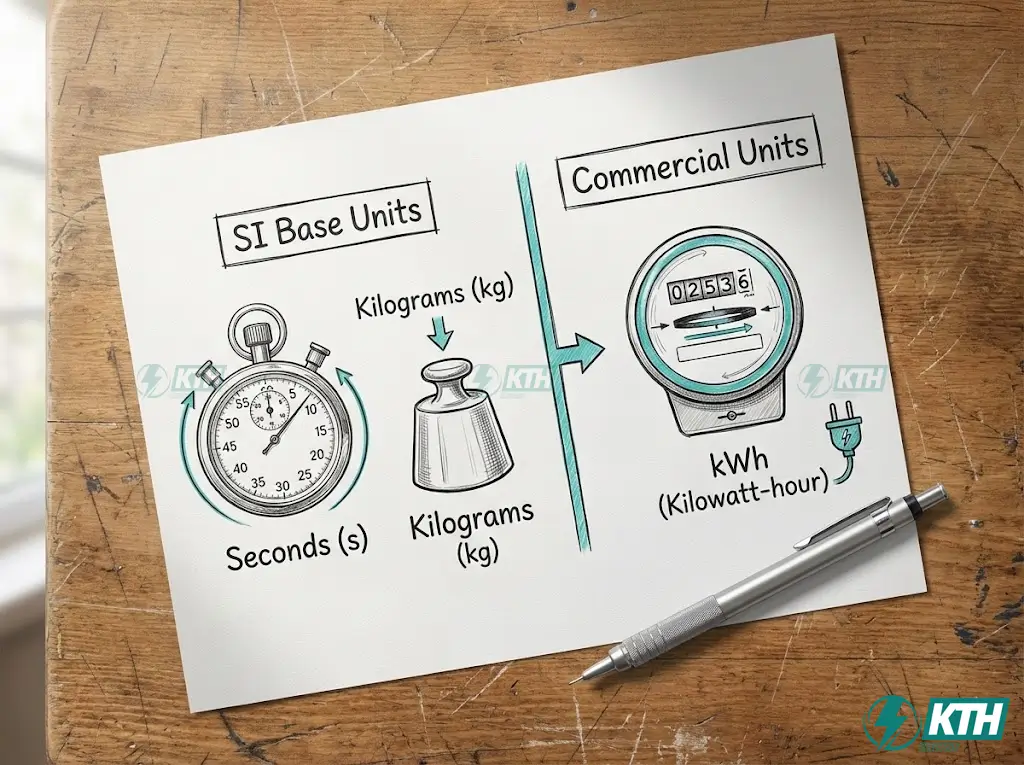
Because 2/3 of the term “kilowatt-hour” sounds like SI, people assume the whole unit is SI. However, the system breaks down at the third component: the Hour. In the International System of Units, the only base unit for time is the Second (s). The hour is a universally accepted unit of time, but it is technically a multiple of the base unit ($60 \text{ minutes} \times 60 \text{ seconds} = 3600 \text{ s}$), not a base unit itself. Therefore, any unit that incorporates “hours” cannot be a pure SI unit.
3. What is “1 Unit” in Electricity? (Terminology)
When discussing billing, you will often hear the term “Unit” or “B.O.T. Unit” (Board of Trade Unit). This is crucial for understanding your bill.
Definition: 1 Unit = 1 kWh
One unit of electrical energy is equal to exactly 1 kWh.
If your bill says you consumed “300 Units,” it means you used 300 kilowatt-hours. This is the standard electricity consumption unit used in Vietnam, the UK, India, and many other regions.
4. The Physics Derivation: From SI to kWh
Let’s put on our engineering hard hats. To truly understand the kWh to SI relationship, we cannot just memorize a conversion factor; we must derive it. This is essential for understanding how we convert electrical energy to mechanical energy or heat.
Step-by-Step Derivation
Step 1: Define the Watt (SI Derived)
Power is the rate at which energy is used. In the SI system, Power is measured in Watts.
$$1 \text{ Watt (W)} = 1 \text{ Joule per second (J/s)}$$
Step 2: Define the Time Constant
As mentioned, the SI unit for time is the Second. The kilowatt-hour uses the Hour.
$$1 \text{ Hour} = 3,600 \text{ seconds}$$
Step 3: The Calculation
Energy is calculated as Power multiplied by Time ($E = P \times t$). If we want to find the value of 1 kWh in SI units (Joules):
2. Multiply by Time: $$1 \text{ kWh} = (1,000 \text{ J/s}) \times (3,600 \text{ s})$$
3. The Golden Formula:
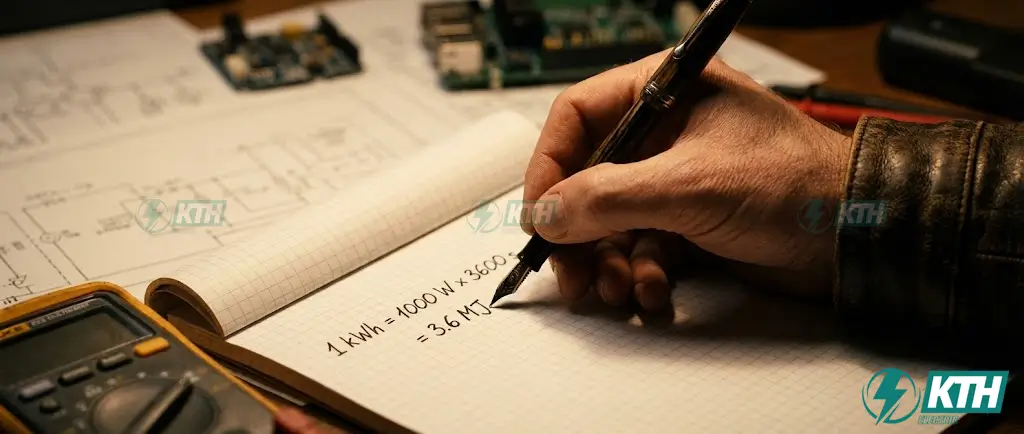
$$1 \text{ kWh} = 3,600,000 \text{ Joules (J)} = 3.6 \text{ MJ}$$
5. How to Calculate kWh (Calculator Formula)
Many users ask “how to find kwh from w” or need a simple electric energy consumption formula. Here is the practical method used by engineers.
The Electric Unit Calculator Formula
To calculate the energy consumption of any appliance, use this 2-step formula:
$$P_{(kW)} = \frac{\text{Watts}}{1000}$$Step 2: Apply the Power Consumption Formula
$$\text{Energy (kWh)} = P_{(kW)} \times \text{Hours used}$$
Example: Calculating kW hours for a Heater
If you have a 1,500 Watt heater running for 4 hours:
- Watts to kW: $1,500 / 1000 = 1.5 \text{ kW}$
- Calculate kWh: $1.5 \text{ kW} \times 4 \text{ hours} = \mathbf{6 \text{ kWh}}$ (or 6 Units)
6. Why Do We Use kWh Instead of Joules?
If the Joule is the “correct” scientific unit, why don’t utility companies use it? Why does your meter read 300 kWh instead of 1,080,000,000 Joules? This is a classic case of User Experience (UX) applied to engineering.
1. The Scale Problem
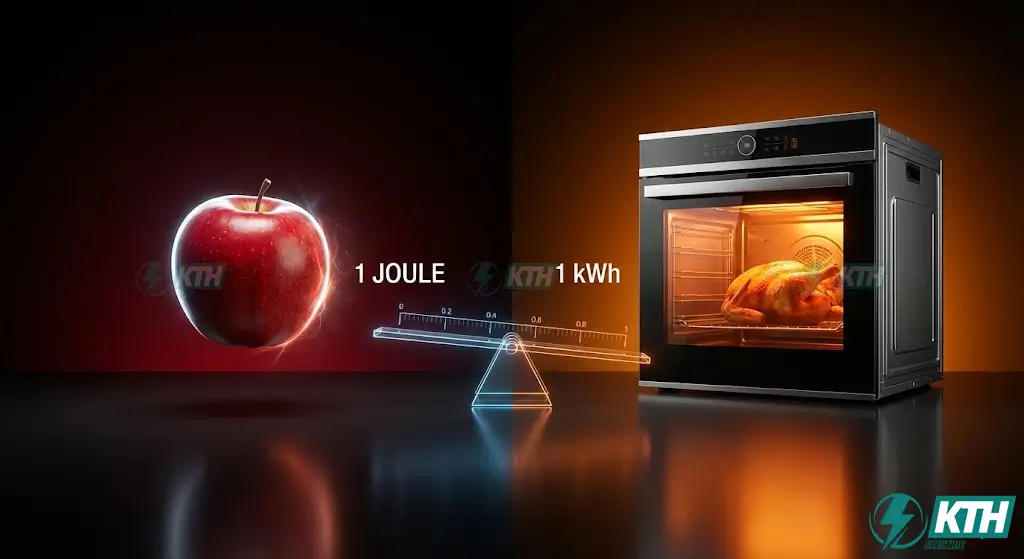
The Joule is an incredibly small unit of energy. To give you a physical sense of it, 1 Joule is approximately the energy required to lift a small apple (100g) one meter vertically. Now, consider a standard household appliance. An electric oven might run at 2,000 Watts (2 kW). If you run that oven for just one hour to roast a chicken:
Calculation in Joules: $2000 \text{ W} \times 3600 \text{ s} = 7,200,000 \text{ Joules}$
If your monthly electricity bill were printed in Joules, an average household using 400 kWh would see a bill for 1,440,000,000 Joules. Human brains struggle to process numbers in the billions for daily transactions.
2. Billing Simplicity
By using the kilowatt-hour, we compress these massive numbers into manageable integers. It is the same reason we measure long driving distances in Kilometers or Miles rather than Meters or Inches. The kWh is a “human-sized” unit, whereas the Joule is a “particle-sized” unit.
7. Comparative Table: kWh vs. Other Energy Units
To further clarify where kWh sits in the hierarchy of energy measurement, we have compiled a comparison table. This relates the kWh to other units you might encounter in thermodynamics, nutrition, or atomic physics.
| Unit Name | Symbol | Is it SI? | Value in Joules | Typical Application |
|---|---|---|---|---|
| Joule | J | Yes (Base) | 1 J | Physics, Thermodynamics |
| Kilowatt-hour | kWh | No | 3,600,000 J | Billing, EV Batteries |
| Megajoule | MJ | Yes | 1,000,000 J | Industrial Machinery |
| British Thermal Unit | BTU | No | ~1,055 J | HVAC, Air Conditioning |
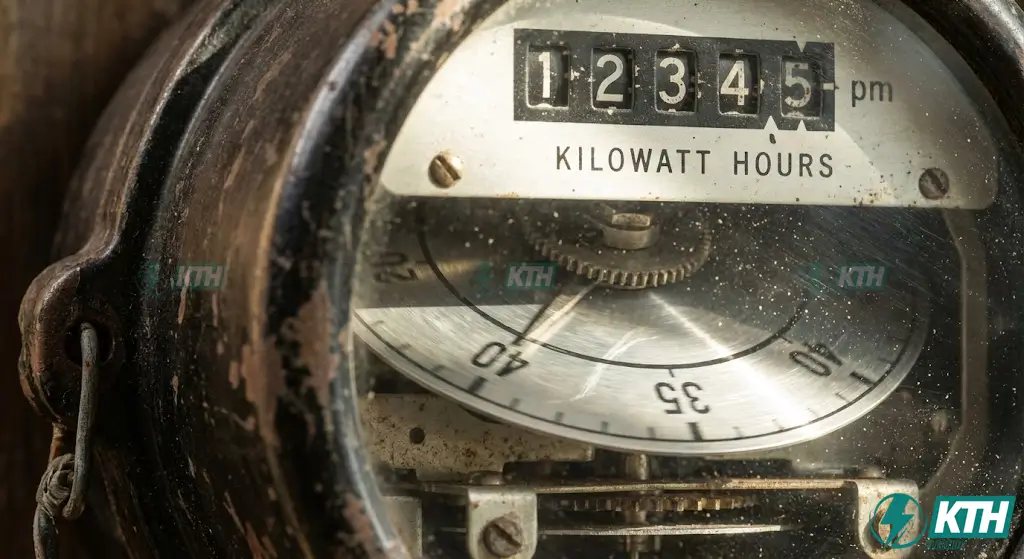
8. Practical Application: Reading Your Meter
1. Digital Smart Meters
Most modern homes now utilize digital “Smart Meters.” These are straightforward.
- How to read: Look at the LCD display showing a sequence of numbers.
- The calculation: Subtract the previous month’s reading from the current reading.
- Example: 15,400 – 15,100 = 300 kWh used.
2. Analog “Dial” Meters
[Image of how to read an analog electric meter dials]Older buildings still use electromechanical meters with spinning discs. Reading these requires a specific technique:
- The Challenge: You will typically see 4 or 5 dials that alternate directions (clockwise vs. counter-clockwise).
- The Rule of Lower Numbers: If the pointer is between two numbers (e.g., between 4 and 5), always record the lower number (4).
- Exception: If between 0 and 9, record 9.
9. Common Misconceptions (The Engineer’s Correction)
In our 20+ years at KTH Electric, we have seen many errors in how people talk about these units. Precision matters, especially when sizing electrical systems or analyzing efficiency.
Misconception #1: Confusing kW and kWh
The Reality: Kilowatts (kW) measure Power—the rate at which you are using electricity right now (like the speedometer in your car). Kilowatt-hours (kWh) measure Energy—the total amount you used over time (like the odometer).
Misconception #2: The “kW/h” Error
We often see marketing materials using the kilowatt per hour formula (kW/h). Mathematically, this implies dividing power by time, which measures the change in power usage (ramp rate), not consumption. The correct syntax is kW × h (multiplication), usually written as kWh.
10. Frequently Asked Questions (FAQ)
Q: What is the SI base unit representation of 1 kWh?
To find the base units, we deconstruct the Joule ($kg \cdot m^2 \cdot s^{-2}$). Since $1 \text{ kWh} = 3,600,000 \text{ Joules}$, the SI base unit representation is: $3,600,000 \cdot kg \cdot m^2 \cdot s^{-2}$.
Q: Can I convert kWh to Watts directly?
No, because kWh measures energy and Watts measures power. You need the time factor to convert. However, you can convert kWh to watts per hour by dividing by the time used. $Power (Watts) = (Energy (kWh) \times 1000) / Time (hours)$.
Q: How do I convert Megajoules (MJ) to kWh?
Simply divide the Megajoule value by 3.6. For example, if a battery stores 100 MJ: $100 / 3.6 = 27.78 \text{ kWh}$.
Conclusion & Key Takeaways
The question “Is kWh an SI unit?” reveals a fascinating divide between the purity of physics and the practicality of engineering. While the SI system strictly recognizes the Joule, the world operates on the Kilowatt-hour to make energy data understandable.
Engineering Cheat Sheet:
- Status: kWh is NOT an SI unit.
- The Gold Standard: The SI unit for energy is the Joule (J).
- The Constant: $1 \text{ kWh} = 3.6 \text{ MJ}$.
- Usage: Use Joules for physics; use kWh for billing and transformer station audits.
At KTH Electric Co., Ltd., we bridge this gap every day. Whether we are calculating the precise Joule rating for a surge protector or estimating the kWh output of a new generator, we ensure the math is right so your lights stay on.