KTH ELECTRIC - COMPREHENSIVE ELECTRICAL SOLUTIONS
Thermal Scan (Thermography) Service
Electrical failures often begin as invisible “Joule Heating” caused by loose connections. Early detection via thermal scanning shifts maintenance from reactive to preventive, significantly reducing fire risks. Protect your facility from invisible threats, reduce downtime, and achieve absolute compliance with NFPA 70B.
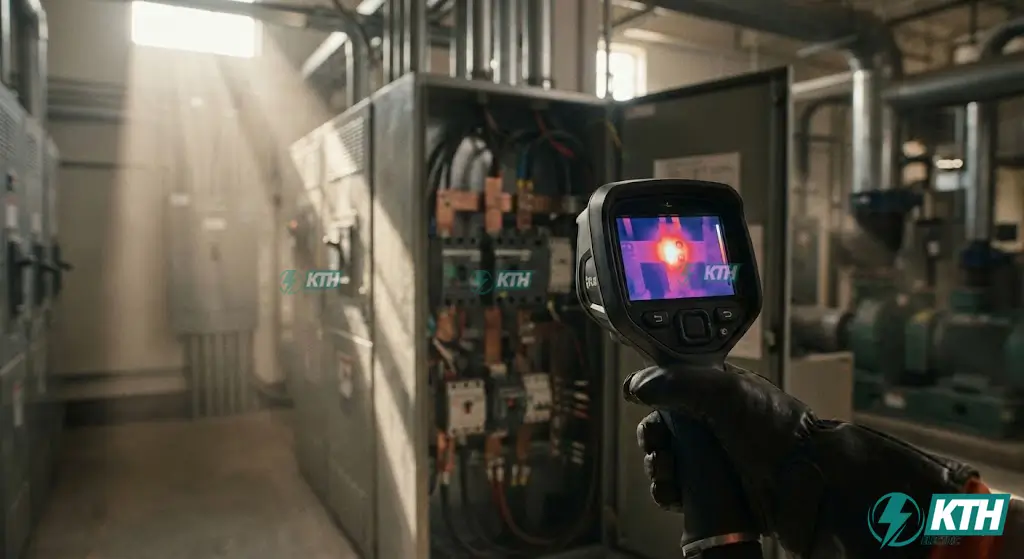
Visualizing the Invisible Threat: Thermal scan revealing a dangerous hotspot in an electrical panel connection.
Quick Summary
- Fire Prevention: Detects hotspots before they cause catastrophic fires.
- NFPA 70B Compliant: Essential for demonstrating due diligence and satisfying insurance policies.
- Non-Destructive Testing: Scanning is done under load (>40%) without turning power off.
- Expert Analysis: Uses NETA’s Delta T criteria to prioritize critical repairs.
What is an Electrical Thermal Scan?
We use advanced Radiometric Thermal Cameras to visualize temperature differences. Unlike standard cameras, a thermal imager detects radiation in the long-wave infrared spectrum.
The Science: Emissivity and Radiation
Every object emits infrared radiation based on its temperature. Accuracy depends on Emissivity. A copper busbar reflects heat (low emissivity), while PVC insulation absorbs and radiates it (high emissivity). A skilled thermographer adjusts for these variables to prevent dangerous false readings.
Why “Non-Destructive”?
The scan is performed under load. We need the system running at >40% load to see it under real-world stress. This allows us to detect faults that would vanish during a de-energized Electrical System Assessment.
Critical Benefits of Thermal Scanning
Standards and Regulations
We align our scanning protocols with rigorous frameworks to ensure your report is legally defensible:
- NFPA 70B: Standard for Electrical Equipment Maintenance. Details scan frequency and repair prioritization.
- NFPA 70E: Focuses on personnel safety (Arc Flash Boundaries and PPE).
- NETA MTS: Defines technical “pass/fail” criteria using the Delta T (ΔT) method.
- ASTM E1934: Standard guide for documenting findings.
The Thermal Scanning Process (SOP)
A professional thermal scan is a systematic engineering process consisting of three phases:
- Preparation: Coordinate peak load conditions (>40%) and open panel covers for direct line-of-sight.
- Execution: Systematic scanning capturing images from multiple angles, taking digital photos alongside thermal images for reference.
- Data Analysis & Reporting: Software analysis to correct for emissivity and calculate Delta T.
Interpreting Thermal Images: The Delta T (ΔT) Criteria
We use the NETA severity criteria to categorize faults based on the temperature difference (ΔT) between the target and a reference component:
| Priority | Temp Rise (ΔT) | Action Required |
|---|---|---|
| PRIORITY 1 🚨 | >40°C Rise | Critical Emergency. Immediate shutdown required to prevent fire. |
| PRIORITY 2 | 21°C – 40°C Rise | Repair ASAP (24-48 hours). Significant thermal stress. |
| PRIORITY 3 | 11°C – 20°C Rise | Repair within 30-60 days. Definite defect. |
| PRIORITY 4 | 1°C – 10°C Rise | Monitor condition. Indicates early oxidation. |

Schedule Your Infrared Thermography Scan Today
Ensure NFPA 70B compliance and protect your facility from unexpected downtime and fire hazards.