
Thermal Scan for Electrical Panels: The Ultimate Guide to Preventive Maintenance & NFPA 70B Compliance
1. The Hidden Risk in Your Electrical System
Quick Insight: Electrical failures often begin as invisible “Joule Heating” caused by loose connections. Early detection via thermal scanning shifts maintenance from reactive to preventive, significantly reducing fire risks.
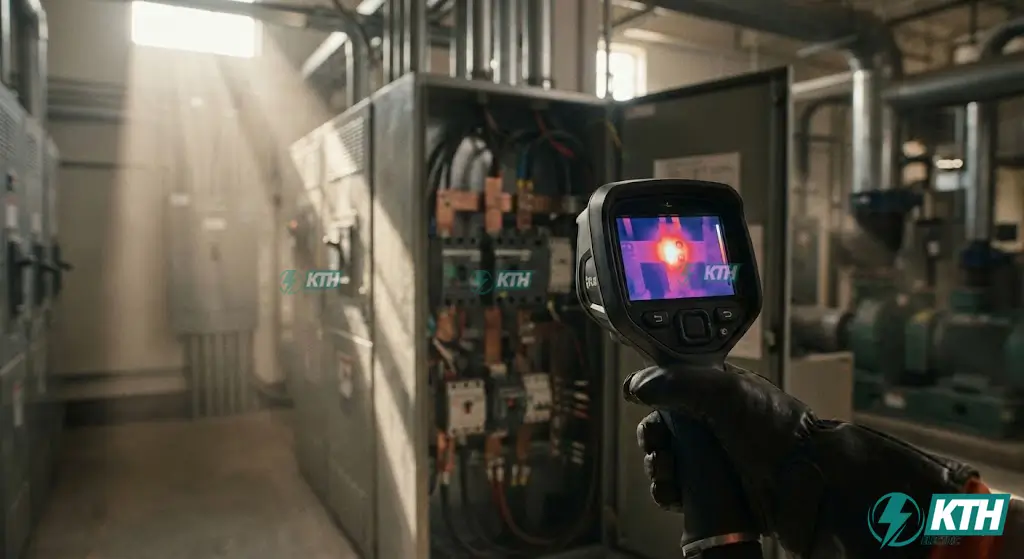
Imagine a fire starting silently inside your main distribution board. There is no smoke yet, no sparking, and no smell of burning plastic. To the naked eye, the breakers look normal. But under the surface, a loose connection on Phase B is generating intense heat, slowly melting the insulation.
This is the “Invisible Threat” of electrical systems: Joule Heating.
In my 20 years as an electrical engineer, I have seen entire production lines shut down due to faults that could have been detected months in advance. According to NFPA data, electrical failures are a leading cause of industrial fires, often attributed to “maintenance failure.”
Traditional maintenance often fails because it relies on visual checks. Electrical Panel Thermal Scanning changes the game. It moves your facility from reactive repairs to a robust Electrical System Maintenance Service strategy, ensuring you fix issues before they cause a shutdown.
This guide is a technical deep dive into Infrared Thermography (IRT), designed for Facility Managers who need to secure their assets and comply with safety standards.
2. What is an Electrical Thermal Scan?
Quick Insight: It is a non-contact, non-destructive testing (NDT) method using Radiometric Thermal Cameras to visualize heat radiation (8–14µm spectrum) on live electrical equipment.
At its core, a Thermal Scan for Electrical Cabinet Service is a non-contact, non-destructive testing (NDT) method.
We use advanced Radiometric Thermal Cameras to visualize temperature differences. Unlike standard cameras, a thermal imager detects radiation in the long-wave infrared spectrum (8–14µm).
The Science: Emissivity and Radiation
Quick Insight: Accuracy depends on Emissivity—how well a material emits heat. A skilled thermographer adjusts settings for materials like copper (low emissivity) versus PVC (high emissivity) to prevent dangerous false readings.
Every object emits infrared radiation based on its temperature. However, accuracy depends on Emissivity. A copper busbar reflects heat (low emissivity), while PVC insulation absorbs and radiates it (high emissivity). A skilled thermographer adjusts for these variables. If ignored, a dangerous 100°C busbar might read as a safe 30°C.
Why “Non-Destructive”?
Quick Insight: Scanning is performed under load (>40%) to reveal real-world stress. De-energized assessments cannot detect these heat-based faults.
The scan is performed under load. We do not turn the power off. We need the system running at >40% load to see the system under real-world stress. This allows us to detect faults that would vanish during a de-energized Electrical System Assessment.
3. Critical Benefits of Thermal Scanning
Quick Insight: The ROI of thermal scanning is driven by Fire Prevention (Safety), Regulatory Compliance (Insurance/NFPA), reduced Unplanned Downtime, and increased Energy Efficiency.
Why invest in an Infrared Thermography Inspection? The ROI is measurable in Safety, Compliance, and Continuity.
A. Fire Prevention (The Safety Imperative)
Benefit: Detects “hotspots” (thermal runaway) early, preventing catastrophic fires in Low Voltage and Main Switchgear.
Electrical fires result from a thermal runaway process. A high-resistance connection generates heat, increasing resistance further. Thermal scanning detects these “hotspots” early (e.g., a 5°C rise), preventing catastrophic failure in your Low Voltage Electrical Cabinet or main switchgear.
B. Insurance and Regulatory Compliance
Benefit: Essential for demonstrating “Due Diligence” (NFPA 70B) and meeting insurance policy requirements to avoid claim denial.
Many insurance policies now require an annual Thermographic Survey. Failure to provide this proof of preventive maintenance can be grounds for denying a claim. Meeting standards like NFPA 70B demonstrates “Due Diligence.”
C. Reduced Unplanned Downtime
Benefit: Allows for planned repairs during scheduled shutdowns, which are significantly cheaper than emergency repairs, especially for Medium Voltage systems.
If a main breaker fails, you lose product and labor hours. Identifying a failing component via a thermal scan allows you to schedule repairs during a planned shutdown. This is particularly critical for complex systems like Medium Voltage Cabinet Maintenance, where lead times for parts can be long.
D. Energy Efficiency
Benefit: Identifies loose connections that waste energy as heat, complementing Energy Monitoring Solutions.
Heat is wasted energy. A loose connection acts as a heater, consuming kilowatts you pay for. Correcting these faults complements your Energy Monitoring Solutions, reducing line losses and improving overall efficiency.
4. Standards and Regulations (Global & Vietnam)
Quick Insight: KTH Electric aligns with NFPA 70B (Maintenance), NFPA 70E (Safety/Arc Flash), NETA MTS (Testing Specs), and ASTM E1934 to ensure reports are technically sound and legally defensible.
At KTH Electric Co., Ltd., we align our scanning protocols with rigorous frameworks to ensure your report is legally defensible:
- ✓NFPA 70B: The standard for Electrical Equipment Maintenance. It details scan frequency and repair prioritization.
- ✓NFPA 70E: Focuses on personnel safety (Arc Flash Boundaries and PPE).
- ✓NETA MTS: Defines technical “pass/fail” criteria using the Delta T (ΔT) method.
- ✓ASTM E1934: Standard guide for documenting findings.
5. The Thermal Scanning Process (SOP)
Quick Insight: A 3-phase engineering process: 1. Preparation (Load >40%, Access), 2. Execution (Systematic multi-angle scanning), and 3. Analysis (Emissivity correction & Report generation).
A professional thermal scan is a systematic engineering process.
Phase 1: Pre-Inspection Preparation
Step: Coordinate peak load conditions and open panel covers for direct line-of-sight.
- Load Management: We coordinate to ensure peak load conditions.
- Access Protocols: Panel covers must be opened for a direct “Line of Sight.”
- Scope Definition: We define the boundaries, whether it’s a specific Busway System Maintenance check or a full facility audit.
Phase 2: The Execution (Scanning)
Step: Systematic scanning from Service Entrance to Distribution Boards, capturing images from multiple angles.
We move systematically from the Service Entrance Section down to Distribution Boards.
- Angle of View: Capturing images from multiple angles to see behind wire bundles.
- Visual Reference: We take a digital photo alongside every thermal image to help your repair team locate the exact component.
Phase 3: Data Analysis & Reporting
Step: Software analysis to correct for emissivity and calculate Delta T, similar to oil data analysis.
We use specialized software to analyze the images, correcting for emissivity and calculating Delta T. This analysis is critical—similar to how we analyze oil data in Transformer Oil Filtration Service, raw data must be interpreted to be useful.
6. Interpreting Thermal Images: The Delta T (ΔT) Criteria
Quick Insight: We use NETA’s Delta T criteria to prioritize repairs. A rise of >40°C is a Critical Emergency (Priority 1), while 1-10°C is a Monitor (Priority 4) condition.
We use the NETA severity criteria to categorize faults based on the temperature difference ($\Delta T$) between the target and a reference component.
- Priority 4 (1°C – 10°C Rise)
Monitor. Indicates early oxidation. - Priority 3 (11°C – 20°C Rise)
Repair within 30-60 days. Definite defect. - Priority 2 (21°C – 40°C Rise)
Repair ASAP (24-48 hours). Significant thermal stress. - Priority 1 (>40°C Rise)
Critical Emergency. Immediate shutdown required to prevent fire.
7. Common Electrical Faults Detected
Quick Insight: The most frequent faults are Loose Connections (vibration), Phase Imbalance (uneven loads), Internal Component Failure (pitting), and requires Advanced Diagnostics for HV insulation.
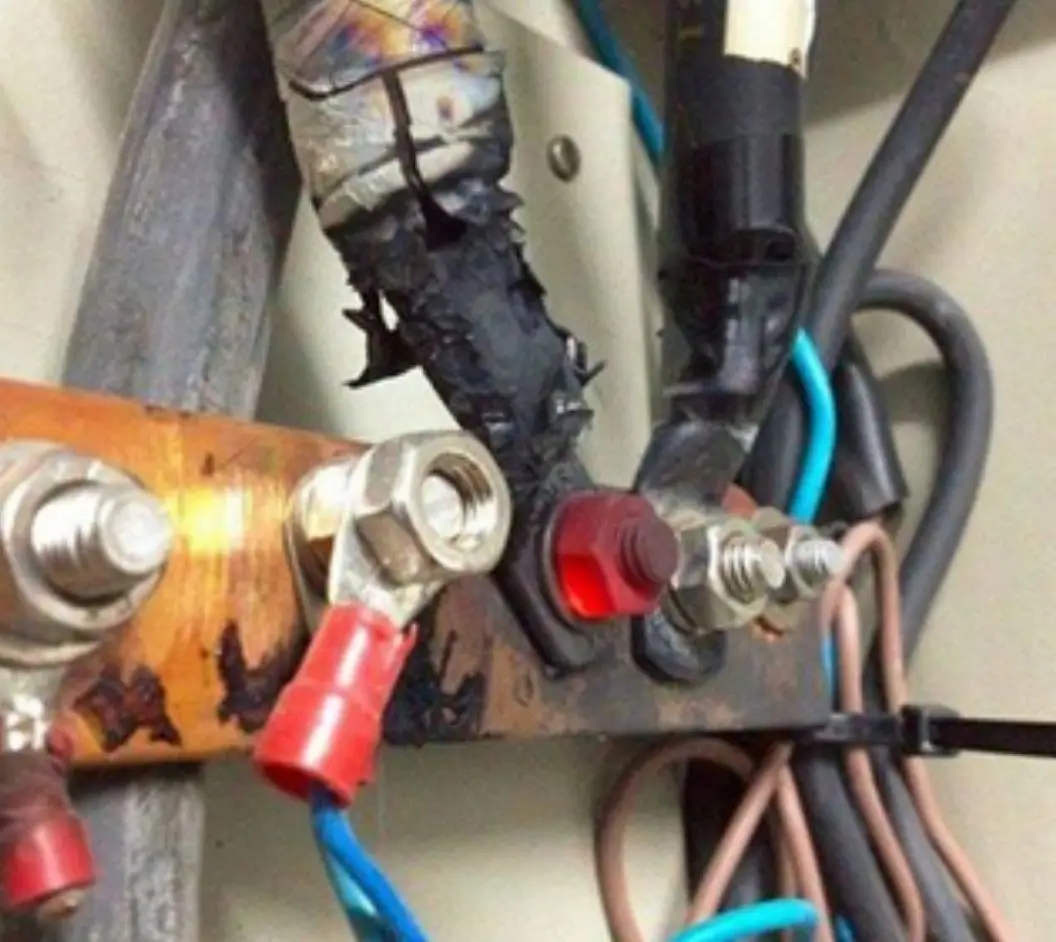 Figure 1: Thermal signature of a high-resistance connection caused by a loose lug.
After scanning thousands of panels in Ho Chi Minh City, here are the most common culprits:
A. Loose Connections
Fault: Vibration causes screws to loosen. Heat is intense at the connection and fades along the wire.
Vibration from nearby equipment—such as large motors or Transformer Stations—can cause screws to loosen. The heat signature is most intense at the connection point and fades along the wire.
B. Phase Imbalance
Fault: One phase carries more load, running hotter. Requires Power Quality Analysis to resolve.
If Phase A carries significantly more load than Phase B, it will run hotter. This stresses the neutral conductor. While thermal scanning spots the heat, solving the root cause often requires Power Quality Analysis to balance the system.
C. Internal Component Failure
Fault: Breaker body glows hot while connections are cool, indicating internal contact pitting.
If a breaker body glows hot while connections are cool, the internal contacts are pitted. This is common in aging equipment and often requires replacement.
D. Advanced Diagnostics Note
Note: Resistive heat is detected by IRT, but high-voltage insulation breakdown is better found with Partial Discharge Measurement.
While thermal scanning is excellent for resistive heat, it may not catch high-voltage insulation breakdown early on. For that, we recommend pairing thermal scans with an Online Partial Discharge Measurement Service.
8. Recommended Equipment Specifications
Quick Insight: Professional accuracy requires specific gear: 320×240 pixel resolution (min), <50mK sensitivity, and -20°C to +500°C range. Smartphone attachments are inadequate.
Do not rely on cheap smartphone attachments. Accurate electrical inspections require:
- Resolution: Minimum 320 x 240 pixels to avoid “Spot Size Ratio” errors.
- Sensitivity (NETD): <50mK (0.05°C) to detect subtle anomalies.
- Temperature Range: -20°C to +500°C.
9. Inspection Frequency and Scheduling
Quick Insight: Critical Infrastructure: Semi-Annually (6 mos). Standard Industrial: Annually. Post-Modification: 48 hours after install (Infant Mortality check).
- Critical Infrastructure: Semi-Annually (Every 6 months).
- Standard Industrial: Annually (Satisfies most insurance requirements).
- Post-Modification: Scan 48 hours after installing new equipment, such as after an Office Electrical Fit-Out, to catch installation errors (“Infant Mortality”).
10. Hiring a Professional vs. DIY
Quick Insight: Professional services provide Certified Experts, Calibrated Equipment, and Actionable Reports. DIY risks safety (Arc Flash) and data misinterpretation.
Thermography is 10% camera and 90% interpretation. Hiring a firm like KTH Electric ensures you get:
- Certified Experts: Trained in heat transfer physics and safety.
- Calibrated Gear: High-end radiometric cameras.
- Actionable Reports: Prioritized repair lists, not just colorful pictures.
Note: For specialized equipment like solar setups, thermal scanning is also vital for Inverter Maintenance and Repair to detect overheating IGBTs.
11. Conclusion: Next Steps for Facility Managers
Electrical failures almost always send warning signals in the form of heat. Ignoring them is a gamble. By implementing a regular Thermal Scan for Electrical Panels, you are choosing reliability over risk.
Ready to secure your electrical system?
Contact the experts at KTH Electric Co., Ltd. today for a consultation and to schedule your baseline thermal inspection.
Connect with our experts:
Meet our Technical Lead: Dr. Khuong Nguyen Vinh.
KTH Electric Co., Ltd.
Address: 251 Pham Van Chieu, An Hoi Tay Ward, Ho Chi Minh City
Hotline: 0968.27.11.99
Email: kthelectric.com@gmail.com