
How to Wire a 20A – 250V Outlet (NEMA 6-20): The Ultimate Safety & Wiring Guide
Installing a NEMA 6-20R (20A – 250V) receptacle is a common requirement for heavy-duty tools like air compressors, welders, or large window air conditioners. However, unlike standard 120V outlets, this configuration often confuses DIYers because of the “missing” neutral connection.
In this guide, we will walk you through the NEC-compliant wiring process, specifically addressing the confusion around the white wire, and correcting dangerous misconceptions found in online forums.
How to Wire a NEMA 6-20 Receptacle?
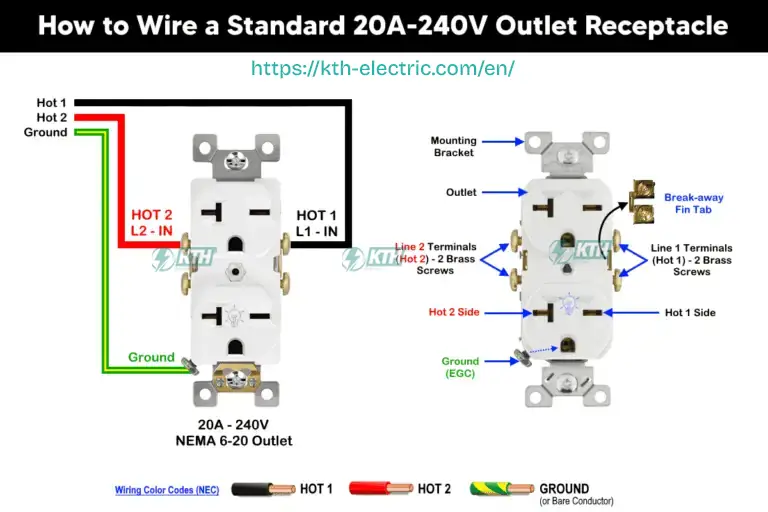
To wire a 20A-250V outlet (NEMA 6-20), use 12-gauge wire. Connect the Black wire (Hot 1) and Red wire (Hot 2) to the two brass terminals (interchangeable). Connect the Bare/Green wire to the green ground screw. The White neutral wire is typically unused in a 3-wire cable setup and must be capped off.
1. Materials & Tools Checklist
Using the correct wire gauge is critical. A 20A circuit requires #12 AWG. Using #14 AWG (common for lights) poses a fire risk.
Required Materials
- NEMA 6-20R Receptacle: Rated 20A/250V. (Has two horizontal/T-shaped slots and a ground).
- 12/3 Cable (Recommended): Contains Black, Red, White, Bare.
- 12/2 Cable (Alternative): Contains Black, White, Bare (Requires re-taping).
- Electrical Tape: Red or Black for re-identifying wires.
Essential Tools
- Non-Contact Voltage Tester: Essential for safety verification.
- Wire Strippers: Calibrated for #12 AWG.
- Torque Screwdriver: To ensure 14-16 in-lbs tightness.
User Question (Jason): “I have a 20A-250V outlet with only 3 screws… No screw on top for the white wire. What do I do?”
The Expert Answer: Jason, a NEMA 6-20R is a 240V-only device. It does NOT use a neutral (white) wire.
- The two brass screws are for the two Hot wires (Black and Red/White-taped).
- The green screw is for Ground.
- There is NO silver screw because 240V circuits for motors/compressors are “Hot-Hot-Ground”.
3. Step-by-Step Installation Protocol
Shut Off Power & Test
Turn off the Double-Pole 20A Breaker at your main panel. Use a voltage tester to confirm zero power. Safety is paramount.
Identify & Prep Wires
Scenario A: Using 12/3 Cable (Best Practice)
- Black: Hot 1
- Red: Hot 2
- White: Neutral (Unused)
- Bare: Ground
Scenario B: Using 12/2 Cable (Common Retrofit)
- Black: Hot 1
- White: MUST be wrapped with electrical tape to signify it is now Hot 2 (NEC 200.7).
- Bare: Ground
Make Connections
Connect Ground First: Wrap the bare/green wire clockwise around the green ground screw and tighten.
Connect Hot Wires:
- Connect the Black wire to one of the brass terminals.
- Connect the Red wire (or taped White wire) to the OTHER brass terminal.
Note: Since it’s AC current, it doesn’t matter which hot wire goes to which brass screw, as long as they are on separate screws.
Handle the Unused Neutral
If you are using 12/3 cable, you will have a leftover White wire. Do not cut it. Instead, cap it with a wire nut and wrap it with electrical tape. Fold it neatly into the back of the box. You might need it in the future if you ever switch to a 120/240V outlet (like NEMA 14-20).
4. Expert Insights: Things Most Guides Miss
Torque Matters!
Loose connections are the #1 cause of electrical fires. Use a torque screwdriver to tighten terminals to 14-16 in-lbs (check manufacturer specs). “Hand tight” is often not enough for 20A continuous loads.
Avoid the “Jason” Mistake
In the forum, Jason asked: “Can I wire the black and red together while putting the white on the opposite side?”
ABSOLUTELY NOT. Connecting Black and Red together creates a direct short circuit (240V Dead Short). This will cause an arc flash and trip your breaker instantly. Never combine hot wires.