


 KTH ELECTRIC - COMPREHENSIVE ELECTRICAL SOLUTIONS
How to Wire a 20A – 250V Outlet (NEMA 6-20): The Ultimate Safety & Wiring Guide
Installing a NEMA 6-20R (20A – 250V) receptacle is a common requirement for heavy-duty tools like air compressors, welders, or large window air conditioners. However, unlike standard 120V outlets, this configuration often confuses DIYers because of the “missing” neutral connection.
In this guide, we will walk you through the NEC-compliant wiring process, specifically addressing the confusion around the white wire, and correcting dangerous misconceptions found in online forums.
How to Wire a NEMA 6-20 Receptacle?
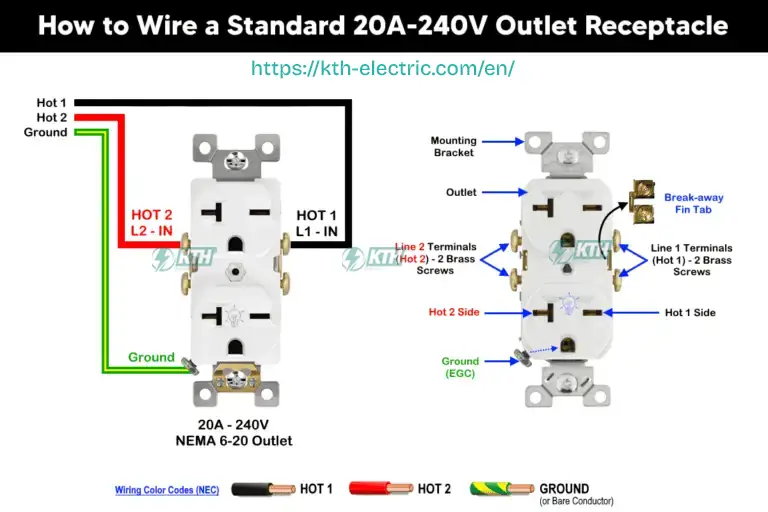
To wire a 20A-250V outlet (NEMA 6-20), use 12-gauge wire. Connect the Black wire (Hot 1) and Red wire (Hot 2) to the two brass terminals (interchangeable). Connect the Bare/Green wire to the green ground screw. The White neutral wire is typically unused in a 3-wire cable setup and must be capped off.
1. Materials & Tools Checklist
Using the correct wire gauge is critical. A 20A circuit requires #12 AWG. Using #14 AWG (common for lights) poses a fire risk.
Required Materials
- NEMA 6-20R Receptacle: Rated 20A/250V. (Has two horizontal/T-shaped slots and a ground).
- 12/3 Cable (Recommended): Contains Black, Red, White, Bare.
- 12/2 Cable (Alternative): Contains Black, White, Bare (Requires re-taping).
- Electrical Tape: Red or Black for re-identifying wires.
Essential Tools
- Non-Contact Voltage Tester: Essential for safety verification.
- Wire Strippers: Calibrated for #12 AWG.
- Torque Screwdriver: To ensure 14-16 in-lbs tightness.
User Question (Jason): “I have a 20A-250V outlet with only 3 screws… No screw on top for the white wire. What do I do?”
The Expert Answer: Jason, a NEMA 6-20R is a 240V-only device. It does NOT use a neutral (white) wire.
- The two brass screws are for the two Hot wires (Black and Red/White-taped).
- The green screw is for Ground.
- There is NO silver screw because 240V circuits for motors/compressors are “Hot-Hot-Ground”.
3. Step-by-Step Installation Protocol
Shut Off Power & Test
Turn off the Double-Pole 20A Breaker at your main panel. Use a voltage tester to confirm zero power. Safety is paramount.
Identify & Prep Wires
Scenario A: Using 12/3 Cable (Best Practice)
- Black: Hot 1
- Red: Hot 2
- White: Neutral (Unused)
- Bare: Ground
Scenario B: Using 12/2 Cable (Common Retrofit)
- Black: Hot 1
- White: MUST be wrapped with electrical tape to signify it is now Hot 2 (NEC 200.7).
- Bare: Ground
Make Connections
Connect Ground First: Wrap the bare/green wire clockwise around the green ground screw and tighten.
Connect Hot Wires:
- Connect the Black wire to one of the brass terminals.
- Connect the Red wire (or taped White wire) to the OTHER brass terminal.
Note: Since it’s AC current, it doesn’t matter which hot wire goes to which brass screw, as long as they are on separate screws.
Handle the Unused Neutral
If you are using 12/3 cable, you will have a leftover White wire. Do not cut it. Instead, cap it with a wire nut and wrap it with electrical tape. Fold it neatly into the back of the box. You might need it in the future if you ever switch to a 120/240V outlet (like NEMA 14-20).
4. Expert Insights: Things Most Guides Miss
Torque Matters!
Loose connections are the #1 cause of electrical fires. Use a torque screwdriver to tighten terminals to 14-16 in-lbs (check manufacturer specs). “Hand tight” is often not enough for 20A continuous loads.
Avoid the “Jason” Mistake
In the forum, Jason asked: “Can I wire the black and red together while putting the white on the opposite side?”
ABSOLUTELY NOT. Connecting Black and Red together creates a direct short circuit (240V Dead Short). This will cause an arc flash and trip your breaker instantly. Never combine hot wires.
| Parameter / Component | NEMA 6-20R Specification | NEC Wiring & Safety Rule |
|---|---|---|
| Voltage & Current Rating | 250V AC, 20 Amps, 2-Pole 3-Wire Grounding | Accepts both NEMA 6-20P (T-slot 20A) and NEMA 6-15P (15A 250V) plugs |
| Circuit Breaker & Wire Size | 20A Double-Pole Breaker + #12 AWG Copper Wire | Do not use #14 AWG wire on a 20A circuit breaker (NEC 240.4(D)) |
| Terminal Connections | Brass = Hot 1 (Black), Silver/Brass = Hot 2 (Red or marked White), Green = Ground | No neutral wire is used; re-identify white wire in 12/2 cable with black/red phase tape per NEC 200.7(C) |
Frequently Asked Questions (FAQ)
What is the most important NEC requirement for How to Wire a 20A 250V Outlet (NEMA 6-20): Complete Guide?
Learn how to wire a NEMA 6-20R (20A 250V) outlet safely with #12 AWG wire and a 2-pole breaker, including proper phase marking when no neutral is used. Always size the copper or aluminum conductor according to NEC Table 310.16 (75°C terminal column where rated) and apply the 80% continuous load rule (125% overcurrent sizing) for continuous loads lasting 3 hours or more.
Why is terminal torque verification critical when installing heavy-duty receptacles?
Under-torqued terminals create high-resistance contact points that generate intense Joule heating (I²R) under load, which is a leading cause of melted receptacles and arc faults. Always use a calibrated torque screwdriver per NEC 110.14(D).
Does a 250V NEMA 6-series receptacle require a neutral wire?
No. Dedicated 250V receptacles (such as NEMA 6-15, 6-20, 6-30, and 6-50) use two hot conductors (L1 and L2) and an equipment grounding conductor (3 wires total). If your appliance requires both 125V and 250V, use a 4-wire NEMA 14-series receptacle instead.

REVIEWED BY:
DR. KHUONG NGUYEN-VINH
✓ Verified Expert
Dr. Khuong Nguyen-Vinh is a Lecturer in Electronic & Computer Systems Engineering at RMIT University Vietnam, dedicated to bridging the gap between advanced theory and practical energy solutions.
With a Ph.D. in Electrical Power Engineering from VSB – Technical University of Ostrava, his research focuses on intelligent control systems for renewable energy, including AI-driven fault detection for solar panels and optimized MPPT algorithms.
💡
Expert Commitment:
“A committed educator, Dr. Khuong mentors the next generation of engineers in power electronics, embedded systems, and sustainable technology integration for Industry 4.0.”