
Comprehensive Guide to Capacitor Symbols: IEC, ANSI, and Schematic Standards
“Schematic symbols are the alphabet of electrical engineering. Misinterpreting a capacitor symbol—specifically regarding polarity—can turn a functioning circuit into a fire hazard.”
Imagine spending weeks designing a high-fidelity audio amplifier or a precision power supply unit. You print the PCB, source the components, and begin soldering. You power it on, expecting a hum of efficiency, but instead, you hear a loud pop followed by the acrid smell of magic smoke. What went wrong? In my 20 years of field experience, a surprising number of these catastrophic failures trace back to a simple, fundamental error: misinterpreting the capacitor symbol on the schematic diagram.
Schematic symbols are the alphabet of electrical engineering. Just as a misplaced comma can change the meaning of a sentence, a misunderstood capacitor symbol—specifically regarding polarity—can turn a functioning circuit into a fire hazard. Whether you are a student just learning Ohm’s Law or a seasoned technician troubleshooting an industrial HVAC control unit, fluency in reading these symbols is non-negotiable. If you are unsure about component integrity, knowing how to test a capacitor is a critical skill to prevent such failures.
This guide serves as the definitive resource for understanding every variation of the capacitor schematic symbol. We will dissect the differences between American (ANSI/IEEE) and European (IEC) standards, explore the nuances of polarized versus non-polarized representations, and ensure you never mistake an anode for a cathode again.
Brought to you by KTH Electric Co., Ltd. – Your trusted partner in electrical system assessment and engineering solutions.
Address: 251 Pham Van Chieu, An Hoi Tay Ward, Ho Chi Minh City
Hotline: 0968.27.11.99 | Email: kthelectric.com@gmail.com
Introduction to Electronic Component Symbols
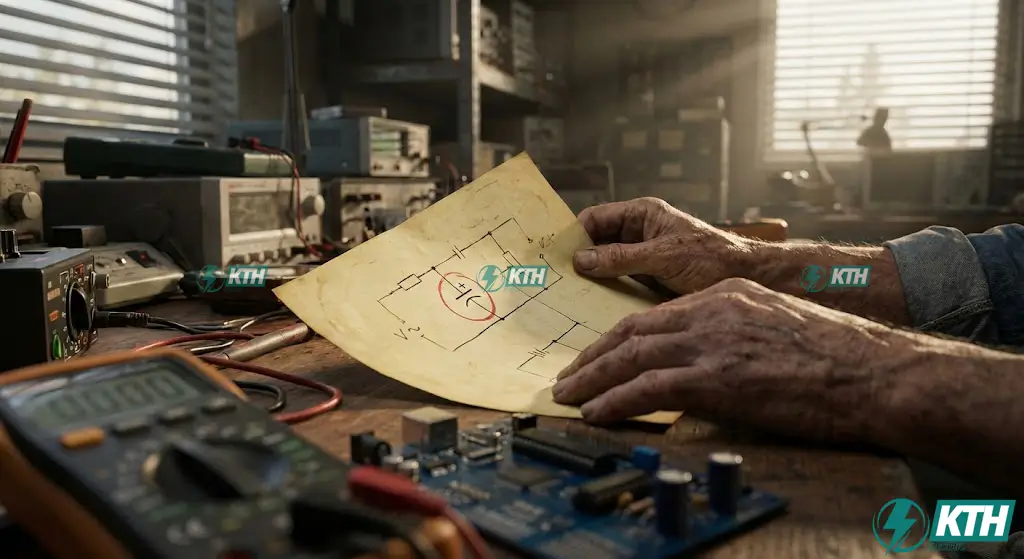
In the realm of electronic design, efficiency and clarity are paramount. A circuit diagram, or schematic, is a graphical representation of an electrical circuit. It uses standardized symbols to represent components like resistors, transistors, and, crucially, capacitors.
The capacitor, a passive component capable of storing energy in an electric field, appears in almost every electronic device, from the tiny smartphone in your pocket to the massive power factor correction units we install at KTH Electric. Because capacitors come in so many physical forms—ceramic discs, aluminum electrolytic cans, rectangular film boxes—schematic symbols act as a unifying abstraction. They tell the engineer the function of the component, not necessarily its physical shape.
However, the “standard” is not always uniform. Depending on where a schematic was drawn—be it in the United States, Germany, or Japan—the capacitor icon can look quite different. Mastering these variations is essential for global engineering literacy.
Non-Polarized Capacitor Symbols
Quick Definition
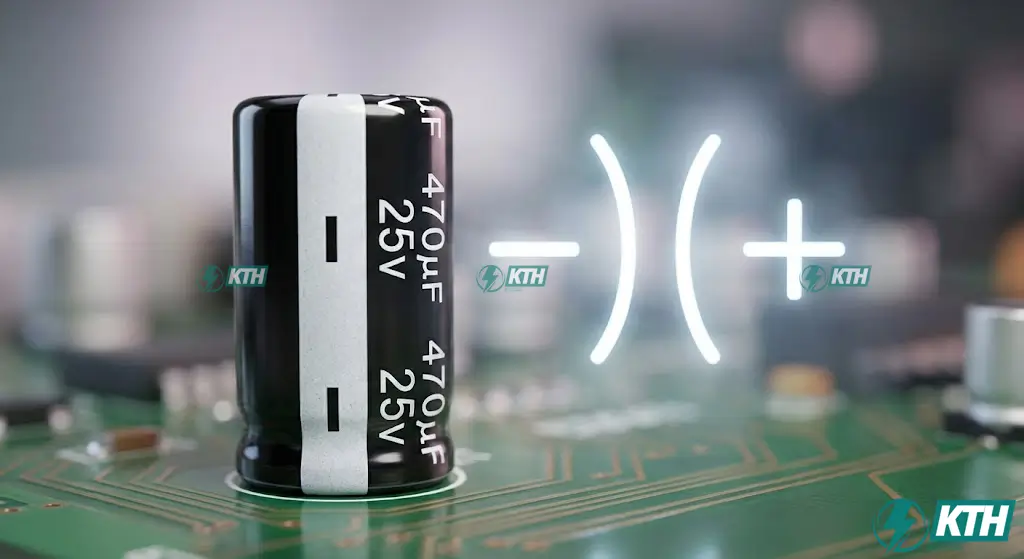
Non-polarized capacitors (like ceramic or film) can be installed in any direction. Their symbol typically consists of two parallel, straight plates separated by a gap, representing the dielectric.
The non-polarized capacitor is the simplest form of this component. Physically, these are often ceramic, mica, or film capacitors used for high-frequency filtering, bypassing, or coupling signal paths where polarity (positive vs. negative) does not matter. You can install them in either orientation without risking failure.
Standard ANSI/IEEE Representation (US)
In the United States, the standard established by ANSI Y32.2 and IEEE 315 depicts a non-polarized capacitor as two parallel lines separated by a gap. These lines are perpendicular to the connecting wires.
- ✓
Visual: Imagine the letter “T” and an inverted “T” facing each other but not touching. - ✓
Meaning: The gap represents the dielectric (insulator) between two conductive plates.
Standard IEC Representation (Europe)
The International Electrotechnical Commission (IEC 60617) standard, widely used in Europe and parts of Asia, uses a very similar symbol for non-polarized capacitors.
- ✓
Visual: Two parallel lines, exactly like the US standard. - ✓
Nuance: Older European schematics may use a rectangular box, but parallel plates are the modern default to avoid confusion with resistors.
Specific Dielectric Symbols
While the generic symbol covers most bases, specialized schematics may use variations to indicate the dielectric material, though this is less common in modern CAD software like Altium or KiCad unless critical for the application:
- Ceramic Disc Capacitor: Usually represented by the standard parallel lines.
- Film Capacitor: Also the standard symbol, sometimes annotated with “MKT” or “MKP” text values.
Polarized Capacitor Symbols
⚠ CRITICAL SAFETY WARNING
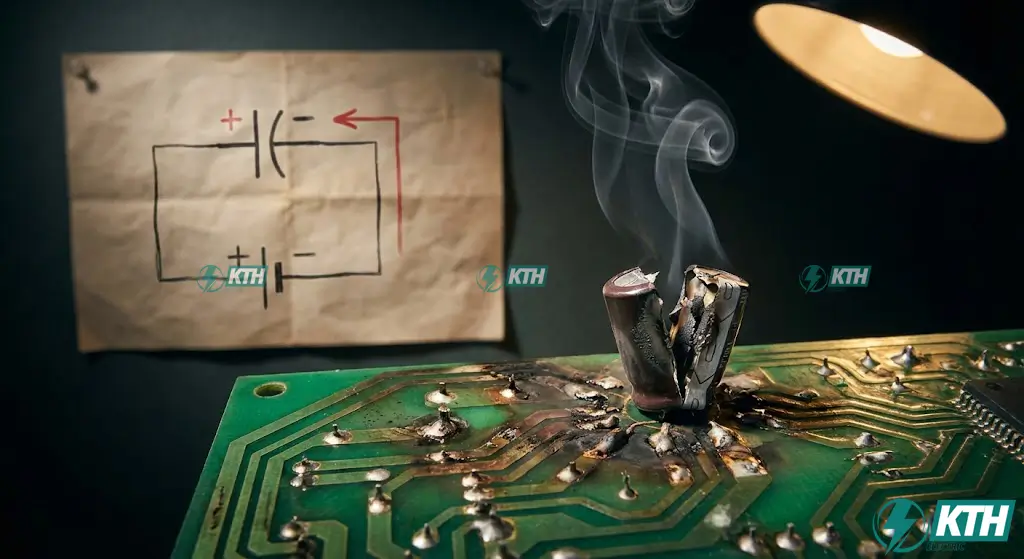
Polarized capacitors (Aluminum Electrolytic/Tantalum) have distinct Positive (+) and Negative (-) terminals. Reverse polarity can cause dielectric breakdown, leading to short circuits, heat, and violent explosions. Correct symbol interpretation is vital.
This is where the stakes get high. Polarized capacitors, such as Aluminum Electrolytic or Tantalum capacitors, have a distinct positive (Anode) and negative (Cathode) terminal. The symbols for these components are designed to clearly indicate orientation.
The US Style (ANSI/IEEE): The Curved Plate
The American standard is visually distinct, featuring one straight plate and one curved plate.
- Straight Line: Positive (+) Anode.
- Curved Line: Negative (-) Cathode.
Why curved? Historically, it represented the outer foil connected to the ground/chassis for shielding.
The EU Style (IEC): The Box and Plus
The IEC 60617 standard uses a more rigid approach, often appearing as an open box or parallel plates with a symbol.
- Visual: Two parallel plates or open rectangle.
- Identification: A small Plus Sign (+) denotes the Positive plate.
The Japanese Style (JIS)
Common in vintage audio equipment. The symbol looks like parallel plates, but the negative electrode is often a cross-hatched or thicker block.
Tantalum Capacitor Symbols
Tantalum capacitors are notorious for their intolerance to reverse polarity. Unlike aluminum electrolytics which might tolerate a brief moment of reverse voltage, tantalums can fail instantly and pyrotechnically. For critical systems, we often recommend comprehensive transformer maintenance services to ensure power quality doesn’t damage sensitive components like these.
Symbol: They generally use the standard polarized symbols described above. However, due to their sensitivity, schematic designers often add an explicit “+” sign regardless of the symbol style (Curved or Straight) to ensure the assembler makes no mistakes.
Variable and Adjustable Capacitors
Not all capacitance values are fixed. In radio frequency (RF) tuning circuits, oscillators, and calibration equipment, we need capacitors that can change their capacity to store charge.
1. Standard Variable Capacitor
This component allows the user to frequently adjust capacitance (e.g., radio tuning dial).
Symbol: Standard capacitor symbol with a diagonal arrow pointing upward/right.
2. Trimmer Capacitor (Preset)
A “set and forget” component adjusted by technicians during calibration.
Symbol: Diagonal line ending in a “T” shape or flat bar (indicating limited adjustability).
3. Ganged Variable Capacitor
Used in complex radios where two parts of a circuit must be tuned simultaneously.
Symbol: Two variable symbols side-by-side, connected by a dashed line.
4. Split-Stator and Butterfly Capacitors
Exotic components for high-power RF transmitters.
Symbol: Visualizes the unique rotor/stator interaction (e.g., butterfly wing shape).
Specialized Capacitor Types and Symbols
Beyond the basics, specialized applications require specialized symbols. As an engineer at KTH Electric, I often encounter these in industrial control schematics.
Feedthrough Capacitor
Used primarily for electromagnetic interference (EMI) suppression, this capacitor allows a wire to pass through it while filtering high-frequency noise to the ground. This is a critical component in harmonic filtering solutions to ensure clean power quality.
Symbol: A standard capacitor with a line piercing through one plate (the feedthrough wire), while the other plate connects to ground.
Memory Backup Capacitor (Supercapacitor)
These high-capacity components bridge the gap between capacitors and batteries, often used for memory backup.
Symbol: Often depicted as a polarized capacitor with multiple parallel plates stacked to imply massive capacity, or annotated with values like 1F or 5F.
Understanding Polarity and Orientation
If there is one section of this guide you memorize, make it this one. Misunderstanding polarity symbols is the leading cause of “capacitor plague”—bulging, leaking, or exploding components on a circuit board, which often necessitates urgent electrical system maintenance service.
Significance of the Curved Plate
In the ANSI/IEEE (US) standard, the curved plate is the visual anchor. It always represents:
- The Negative (-) terminal.
- The Cathode (in electrolytic terms).
- The Lower Potential side of the circuit.
Conversely, the straight plate represents the Positive (+) terminal or Anode.
Identifying Anode (+) and Cathode (-) on Diagrams
In the IEC (EU) standard, the symbols rely less on shape and more on explicit markings.
- Look for the empty rectangle (Positive) vs. the filled rectangle (Negative) in older drawings.
- In modern diagrams, look for the simple parallel lines with a small “+” sign. The line closest to the “+” is positive.
Physical Component vs. Schematic
A common point of confusion for junior engineers at KTH Electric involves translating the symbol to the real world. This topic frequently appears in our electrical engineering interview questions.
- Schematic: Shows logical connection (Positive vs. Negative).
- Physical Component (Radial Electrolytic): The Long Lead is Positive (+). The side of the can with the Gray Stripe is Negative (-).
- Physical Component (SMD Tantalum): The side with the Line/Bar is actually Positive (+). Note: This is the opposite of diodes and aluminum electrolytics! Always double-check the datasheet.
Reverse Polarity Risks
Connecting a polarized capacitor backward causes electrochemical reactions that generate hydrogen gas. Pressure builds up inside the metal can until the safety vent bursts (the “pop”) or the can launches itself off the board. In high-voltage industrial circuits, such as those found in inverter maintenance and repair, this can cause arc faults.
Standards and Specifications
Why do these differences exist? It comes down to the governing bodies that established the rules decades ago.
- IEEE 315 / ANSI Y32.2
This is the American National Standard for graphic symbols. It favors the curved-plate capacitor symbol. If you are working with schematics from US-based companies (e.g., Texas Instruments), you will see this style. - IEC 60617
The International Electrotechnical Commission sets the standard for Europe. It favors the parallel-plate symbol with explicit polarity signs. This style is dominant in schematics from companies like Siemens or Philips. - JIS C 0617
The Japanese Industrial Standard often mirrors IEC but retains unique legacy symbols (like the cross-hatched negative plate). Crucial when servicing equipment from Sony or Panasonic.
Reference Chart: Capacitor Symbol Cheat Sheet
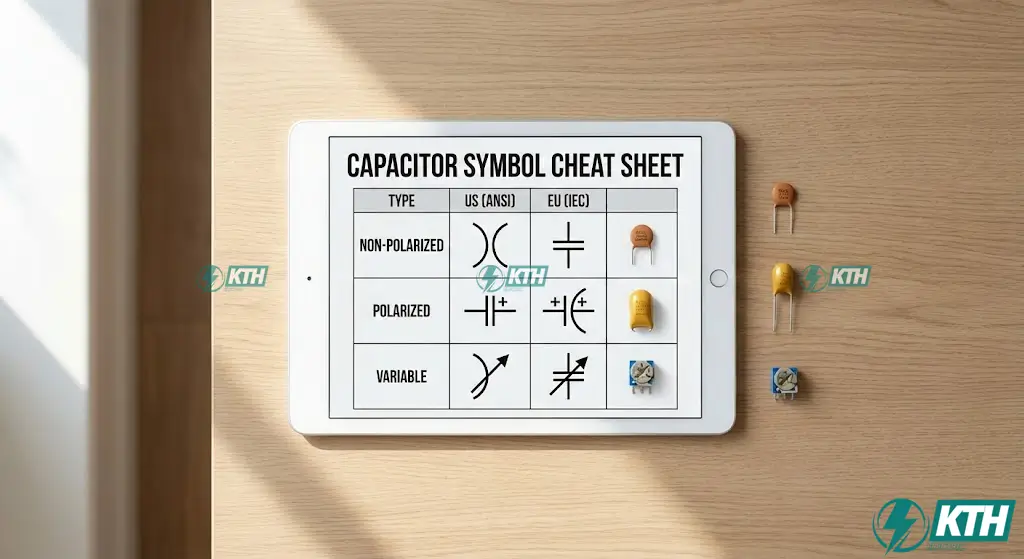
For quick reference, here is a breakdown of how the same component appears across different standards.
| Component Type | ANSI / IEEE (US) | IEC (Europe) | Polarity Notes |
|---|---|---|---|
| Non-Polarized | Parallel Lines (Straight) | Parallel Lines (Straight) | No polarity. Orientation doesn’t matter. |
| Polarized | One Straight, One Curved | Open Rectangle or Parallel Lines with “+” | Curved is Negative. + indicates Positive. |
| Variable | Curved/Straight with Arrow | Parallel Lines with Arrow | Arrow indicates adjustability. |
| Trimmer | Curved/Straight with “T” End | Parallel Lines with “T” End | “T” indicates preset adjustability. |

Common Mistakes in Reading Capacitor Schematics
Even experienced engineers can trip up. Here are the most frequent errors we see during electrical system assessment and design reviews at KTH Electric.
1. Confusing Polarized and Non-Polarized
Mistake: Assuming a symbol with two straight lines is non-polarized, even when a tiny “+” sign is hiding near the net label.
Fix: Always check the component value. If it’s >1µF, it’s likely polarized.
2. Misinterpreting Variable vs. Trimmer
Mistake: Designing a front panel with a knob for a capacitor that was actually intended to be a set-and-forget internal trimmer.
Fix: Look for the “T” line ending versus the full arrowhead.
3. Overlooking Voltage Ratings
Mistake: The symbol is generic. It doesn’t tell you if the capacitor is rated for 10V or 1000V. This is critical in medium voltage cabinet maintenance.
Fix: Cross-reference the symbol ID (e.g., C4) with the BOM.
4. Battery vs. Capacitor Confusion
Mistake: Confusing a DC voltage source symbol with a non-polarized capacitor.
Fix: In a battery, lines are different lengths. In a capacitor, lines are equal length.
Conclusion
The humble capacitor symbol is more than just lines on a page; it is a precise language that conveys function, technology, and safety constraints. Whether you are dealing with the curved plates of the ANSI standard or the rectangular precision of the IEC, the ability to decode these symbols instantly is the mark of a competent electrical professional.
At KTH Electric, we understand that attention to detail in the schematic phase prevents costly downtime in the operational phase. We hope this guide helps you navigate your next project with confidence.
Frequently Asked Questions (FAQs)
Q1: Why is one plate curved in the US capacitor symbol?
A: Historically, the curved plate represented the outer foil of a wound capacitor, which was connected to the ground/chassis to shield the inner layers from noise. Today, it primarily serves as a visual indicator for the Negative (-) terminal.
Q2: What is the symbol for a supercapacitor?
A: There isn’t one globally agreed-upon symbol yet. However, most diagrams use the standard Polarized Capacitor symbol. Some CAD libraries use a variation with multiple parallel plates stacked together to indicate the immense charge capacity.
Q3: How do you draw a capacitor in CAD software like Altium or Eagle?
A: You generally don’t “draw” it from scratch. You select it from the component library. However, you must choose the correct footprint. Ensure you select a symbol that matches your regional standard (e.g., selecting the “Capacitor_Pol_US” library item for an ANSI symbol). This is a vital step in any office electrical fit-out design process.
Q4: What is the difference between a battery symbol and a capacitor symbol?
A: It’s all about line length.
• Capacitor: Both parallel lines are the same length.
• Battery (DC Source): One line is longer (Positive) and one is shorter (Negative).