

Active, Reactive, Apparent, and Complex Power: A Comprehensive Guide
Part 1: The Three Pillars of AC Power
Active, Reactive, Apparent, and Complex Power
Understanding the different forms of power is fundamental in electrical engineering, especially when dealing with AC circuits. These concepts—Active, Reactive, Apparent, and Complex Power—define how energy is transferred, stored, and utilized in electrical systems. For a practical application of these concepts in assessing system health, you might be interested in our electrical system assessment services.
What is Active Power (P)?
💡 Definition:
Active Power is the actual power which is really transferred to the load such as transformer, induction motors, generators etc and dissipated in the circuit.Unit: Watts (W) where 1W = 1V x 1A.
Alternative words used for Real Power are Actual Power, True Power, Watt-full Power, Useful Power, Real Power, and Active Power. It is denoted by (P) and measured in units of Watts (W).
Active Power in DC Circuits:
In DC Circuits, power supply to the DC load is simply the product of Voltage across the load and Current flowing through it i.e., P = V I because in DC Circuits, there is no concept of phase angle between current and voltage. In other words, there is no frequency (f) or Power factor in DC Circuits.
Active Power in AC Circuits:
But the situation in Sinusoidal or AC Circuits is more complex because of phase difference (θ) between Current and Voltage. Therefore average value of power (Real Power) is P = VI Cosθ is in fact supplied to the load.
In AC circuits, When circuit is pure resistive, then the same formula used for power as used in DC as P = V I.
Active Power Formulas:
- $P = V \times I$ (In DC circuits)
- $P = V \times I \times \cos\theta$ (in Single phase AC Circuits)
- $P = \sqrt{3} \times V_L \times I_L \times \cos\theta$ or $P = 3 \times V_{ph} \times I_{ph} \times \cos\theta$ (in Three Phase AC Circuits)
- $P = \sqrt{S^2 – Q^2}$ or $P = \sqrt{VA^2 – VAR^2}$
- $kW = \sqrt{kVA^2 – kVAR^2}$
Where: P = Power in Watts, V = Voltages in Volts, I = Current in Amperes, Cosθ = Power Factor, VL = Line Voltage, IL = Line Current, S = Apparent Power in VA, Q = Reactive Power in VAR.
What is Reactive Power (Q)?
💡 Definition:
Also known as Use-less Power or Watt less Power. The powers that continuously bounce back and forth between source and load is known as reactive Power (Q).Unit: Volt-Ampere reactive (VAR) where 1 VAR = 1V x 1A.
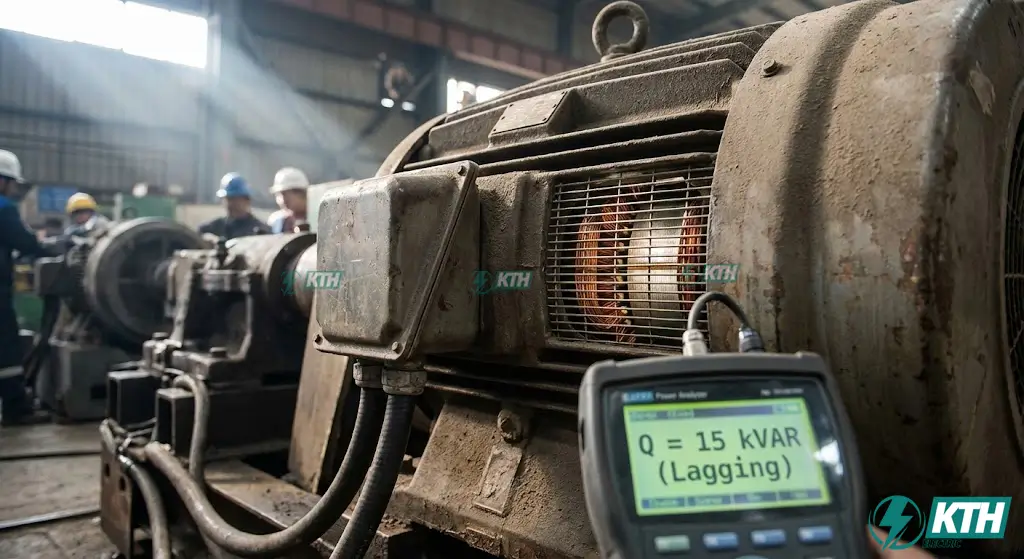
Power merely absorbed and returned in load due to its reactive properties is referred to as reactive power. Reactive Power represent that the energy is first stored and then released in the form of magnetic field or electrostatic field in case of inductor and capacitor respectively.
This is particularly relevant when dealing with motor monitoring solutions where inductive loads are prevalent.
In more simple words, in Inductor or Capacitor, how much magnetic or electric field produced by 1A x 1V is known as the unit of Reactive Power.
Reactive Power Formulas:
$Q = V \times I \times \sin\theta$
Reactive Power = $\sqrt{Apparent Power^2 – True Power^2}$
$VAR = \sqrt{VA^2 – P^2}$
$kVAR = \sqrt{kVA^2 – kW^2}$
What is Apparent Power (S)?
💡 Definition:
The product of voltage and current if and only if the phase angle differences between current and voltage are ignored. Total power in an AC circuit, both dissipated and absorbed/returned is referred to as apparent power.Unit: Volt-Ampere (VA) i.e. 1VA = 1V x 1A.
The combination of reactive power and true power is called apparent power. In an AC circuit, the product of the r.m.s voltage and the r.m.s current is called apparent power which is denoted by (S). It is the product of Voltage and Current without phase angle.
When the circuit is pure resistive, then apparent power is equal to real or true power, but in inductive or capacitive circuit, (when Reactances exist) then apparent power is greater than real or true power.
Apparent Power Formulas:
$S = V \times I$
$S = \sqrt{P^2 + Q^2}$
Apparent Power = $\sqrt{True Power^2 + Reactive Power^2}$
$kVA = \sqrt{kW^2 + kVAR^2}$
Part 2: Advanced Concepts & Visualization
What is Complex Power (S)?
The Complex sum of Real Power (P) and Reactive Power (Q) is known as Complex Power which can be expressed like $S = P+jQ$ and measured in terms of Volt Amps Reactive (generally in kVAR).
It may also be expressed as $S=VI^*$ where “I*” is the conjugate of the complex current I. This current “I” flows through a reactive load Z caused by the Voltage.
- $Z = R – jX_C$
- $I = I_P + jI_Q$
- $Cos\theta = R / |Z|$ (leading)
- $I^* = I_P – jI_Q$
- $S = P – jQ$
A Capacitive Load provide Leading VARS (i.e. it eliminates VARS and improves the overall power factor of the system). That’s why capacitors are used to correct and improve the power factor. Learn more in How to Test a Capacitor.
- $Z = R + jX_L$
- $I = I_P – jI_Q$
- $Cos\theta = R / |Z|$ (lagging)
- $I^* = I_P + jI_Q$
- $S = P + jQ$
An Inductive Load provide lagging VARS (i.e. it added VARS and decrease the overall power factor).
Good to know:
- Resistor absorbs the real power and dissipates in the form of heat and light.
- Inductor absorbs the reactive power and dissipates in the form of magnetic field.
- Capacitor absorbs the reactive power and dissipates in the form of electric or electrostatic field.
The Power Triangle
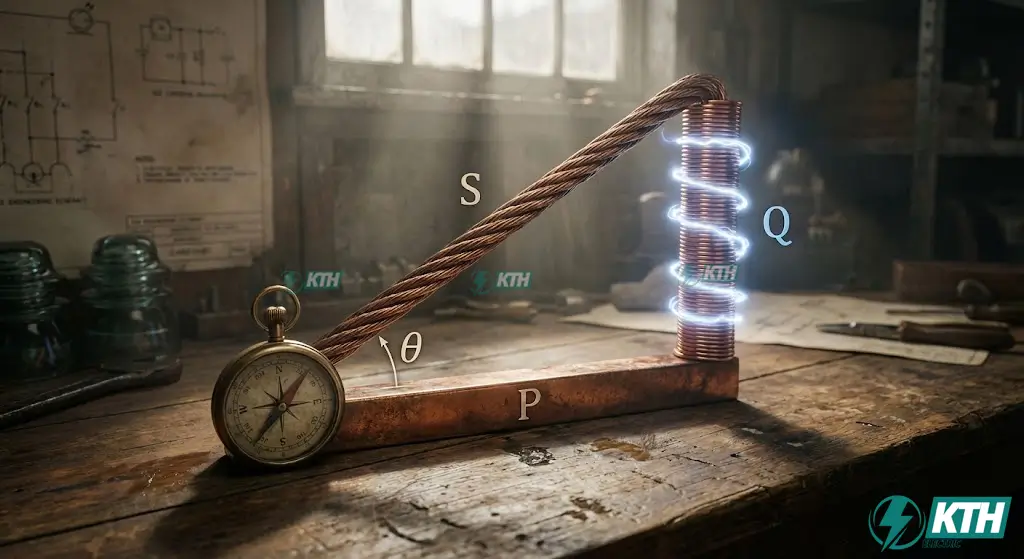
Active, Reactive, Apparent Power and Power factor are trigonometrically related to each other as shown in the Power Triangle.
- Base: Active Power ($P$)
- Perpendicular: Reactive Power ($Q$)
- Hypotenuse: Apparent Power ($S$)
- Angle: $\theta$ (Phase angle between Voltage and Current)
From the triangle:
$\cos\theta = \frac{P}{S}$ (Power Factor)
$\sin\theta = \frac{Q}{S}$
$\tan\theta = \frac{Q}{P}$
Role of Active and Reactive Power (Analogies)

For easy explanation, all the related quantities can be easily understand by the funny Lays Chips and Beer Analogy for Real or True or Active Power, Reactive Power, Apparent Power and power factor.
1. Lays Chips Analogy
Imagine buying a bag of chips. The chips you eat are the Real Power. The air/nitrogen inside the bag that takes up space but isn’t food is the Reactive Power. The entire bag (Chips + Air) is the Apparent Power.
2. Beer Analogy
- 🍺 Real Power (Active): The liquid beer that you actually drink and enjoy. This represents the useful energy.
- ☁️ Reactive Power: The foam on top. It takes up space in the glass (capacity) but isn’t the beer itself. However, it’s a necessary part of the “draft beer experience” (just as reactive power is necessary for magnetic fields).
- 🥛 Apparent Power: The total contents of the glass (Liquid + Foam). The glass must be sized to hold both.
Why is Reactive Power called “Imaginary”?
There is an important relationship between active and reactive power. Let’s understand why active power (P) is called true power and reactive power (Q) is called imaginary power.
Consider an inductor (coil). When current passes through it, it stores energy in a magnetic field. In an AC circuit:
- Quarter Cycle 1: Current increases, inductor consumes energy to build magnetic field.
- Quarter Cycle 2: Current decreases, inductor releases stored energy back to the source.
So, the inductor is exchanging energy with the voltage source. It is not consuming power to do work (like heat or motion), but rather “borrowing” and “returning” it. This energy exchange is why it’s called Imaginary Power (Reactive Power).
Real-World Application: Rating of Voltage Controller at Your Home
In your house, suppose you have an air-conditioner, having consumption of 2 kW power. You may require a stabilizer (voltage controller) with this. Stabilizer is just a transformer. What may be the rating of stabilizer?
Answer: Rating of stabilizer maybe around 4 kVA. The reason is that air-conditioner consumes reactive power also (it has a motor inside it). So, the kVA rating of stabilizer is certainly more than 2 kVA (Active Power). Though the reactive power is imaginary power i.e. exchange of energy between air-conditioner and voltage supply but for this exchange of energy, current flows between air-conditioner and stabilizer, that passes through the winding of stabilizer (transformer), therefore just a 2 kVA stabilizer is not sufficient.
In most of the countries, the meters installed in residential areas are KW-Hr meter; so you have to pay electricity bill of active power; reactive power is free; but any transformer or voltage controller is to be installed accommodates reactive power also, hence rated in kVA (apparent power).
Important Notes:
- Induction motor always runs at lagging power factor as it always consumes reactive power along with active power.
- Synchronous generator can run at leading, lagging or unity Power factor.
- If direction of P & Q is same it is lagging PF. If direction of P & Q is opposite it is leading PF.
For further reading on practical electrical applications, check out our guide on Wire Size for 50A Breaker (NEC Guide). Additionally, understanding components like capacitors is crucial for managing reactive power; learn more in our article on How to Test a Capacitor. If you are preparing for a job in this field, review our Electrical Engineering Interview Questions.