
Capacitor & Types Of Capacitors: The Ultimate Guide
Fixed, Variable, Polar & Non-Polar | 2025 Comprehensive Edition
Reading Time: 15 Minutes
Introduction
A capacitor is one of the most fundamental passive electronic components, functioning as the “heartbeat” of timing circuits and the “reservoir” in power supplies. Whether you are designing a simple LED flasher or a complex motherboard, understanding capacitors is non-negotiable.
In this comprehensive guide, we will dissect the anatomy of capacitors, explore every type from Ceramic to Supercapacitors, and provide practical selection guides for your projects. For a broader check of your facility’s health, consider our professional electrical system assessment.
Part 1: Fundamentals of Capacitance
1. What is a Capacitor?
💡 Direct Answer:
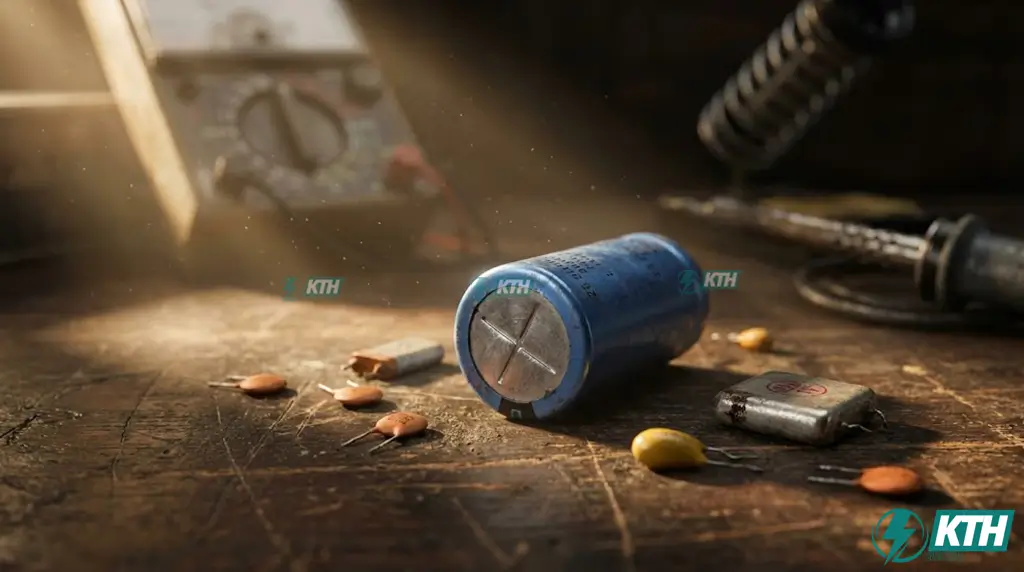
A capacitor is a passive two-terminal electronic component that stores electrical potential energy in an electric field. It consists of two conductive plates separated by an insulating material called a dielectric.
A capacitor is a two-terminal passive electronic component that stores electrical energy in an electric field. Structurally, it consists of two conducting metal plates (electrodes) separated by an insulating material known as the dielectric. To maintain the integrity of such insulation in high-voltage systems, referencing insulation monitoring solutions is highly recommended.
Capacitance
Capacitance (C) is the ability of a capacitor to store charge ($Q$) per unit of voltage ($V$).
- Unit: Farad (F).
- Formula: $C = Q / V$
- Definition: One Farad is the capacitance when a charge of one coulomb causes a potential difference of one volt across its terminals.
⚠️ Engineer’s Note: Capacitance is always a positive value. In practical electronics, 1 Farad is huge. We mostly deal with microfarads ($\mu F$), nanofarads ($nF$), and picofarads ($pF$).
Circuit Symbols
Identifying the correct symbol is crucial to avoid connection errors, especially with polarized components.
Part 2: Fixed Capacitors – Polarized
2. Types Of Capacitors: Overview
Capacitors are broadly classified based on their construction and dielectric materials. Here is the high-level classification:
Quick Comparison: Fixed vs. Variable
| Feature | Fixed Capacitor | Variable Capacitor |
|---|---|---|
| Capacitance | Constant, set during manufacturing | Adjustable (Mechanically or Electrically) |
| Typical Use | Power supply, Filtering, Timing | Tuning radios, Impedance matching |
| Cost | Generally Low | Higher |
3. Fixed Capacitors
Fixed capacitors are divided into two critical categories: Polar and Non-Polar.
3.1 Polar Capacitors (Polarized)
Polar capacitors have distinct positive (+) and negative (-) terminals.
🚨 Safety Warning: Never reverse the polarity of a polar capacitor. Doing so can cause the dielectric to break down, leading to gas buildup, leakage, and potentially a violent explosion. Always check the stripe on the casing (usually indicates negative).
3.1.1 Electrolytic Capacitors
These use an electrolyte (liquid or solid) to achieve a very high capacitance-to-volume ratio. They are the go-to choice for low-frequency applications like power supply filtering. Implementing these in systems often requires careful harmonic filtering solutions to ensure longevity.
A. Aluminum Electrolytic Capacitors
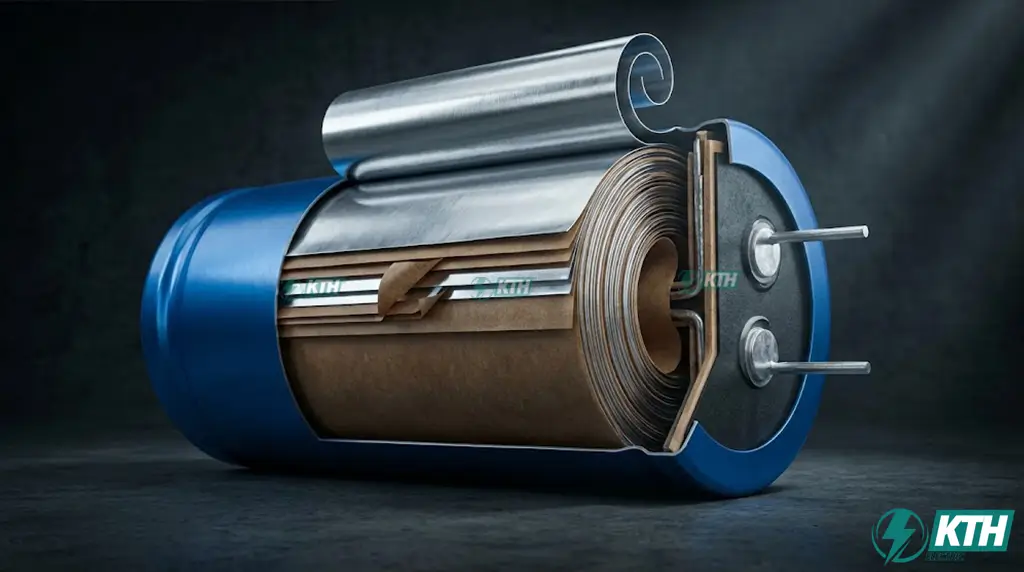
- Construction: Aluminum anode oxidized to form an insulating $Al_2O_3$ layer.
- Sub-types:
- Wet/Non-Solid: Self-healing but can dry out over time (lower lifespan).
- Solid (Polymer/MnO2): No evaporation, lower ESR, longer life, but more expensive.
B. Tantalum Electrolytic Capacitors
- Material: Tantalum anode with a very thin oxide layer.
- Key Feature: High capacitance in a tiny package (High Volumetric Efficiency).
- Pros: Stable over temperature, long shelf life.
- Cons: Intolerant to voltage spikes and reverse polarity (can catch fire).
C. Niobium Electrolytic Capacitors
An alternative to Tantalum, offering better availability and safety (less likely to ignite), though slightly larger in size.
3.1.2 Supercapacitors (Ultra-Capacitors)
These bridge the gap between capacitors and rechargeable batteries.
- Capacitance: Massive range (100F to 12,000F).
- Voltage: Low (typically 2.5V – 2.7V per cell).
- Types:
- EDLC (Electrostatic Double-Layer): Stores charge physically (carbon electrodes).
- Pseudocapacitors: Stores charge electrochemically (redox reaction).
- Hybrid: Combination of both.
Comparison: Electrolytic vs. Supercapacitor
| Feature | Electrolytic Capacitor | Supercapacitor |
|---|---|---|
| Storage Mechanism | Electrostatic | Double-layer / Electrochemical |
| Capacitance | $\mu F$ to $mF$ range | 1F to 5000F+ |
| Discharge Time | Microseconds to Milliseconds | Seconds to Minutes |
| Application | Filtering, Smoothing | Memory Backup, Engine Start, Regenerative Braking |
Part 3: Fixed Capacitors – Non-Polar
3.2 Non-Polar Capacitors
💡 Direct Answer:
Non-polar capacitors have no specific polarity requirements and can be connected in any direction. They are widely used in AC circuits, high-frequency signals, and coupling applications.
These have no polarity constraints and are typically used in AC circuits or high-frequency DC applications.
3.2.1 Ceramic Capacitors
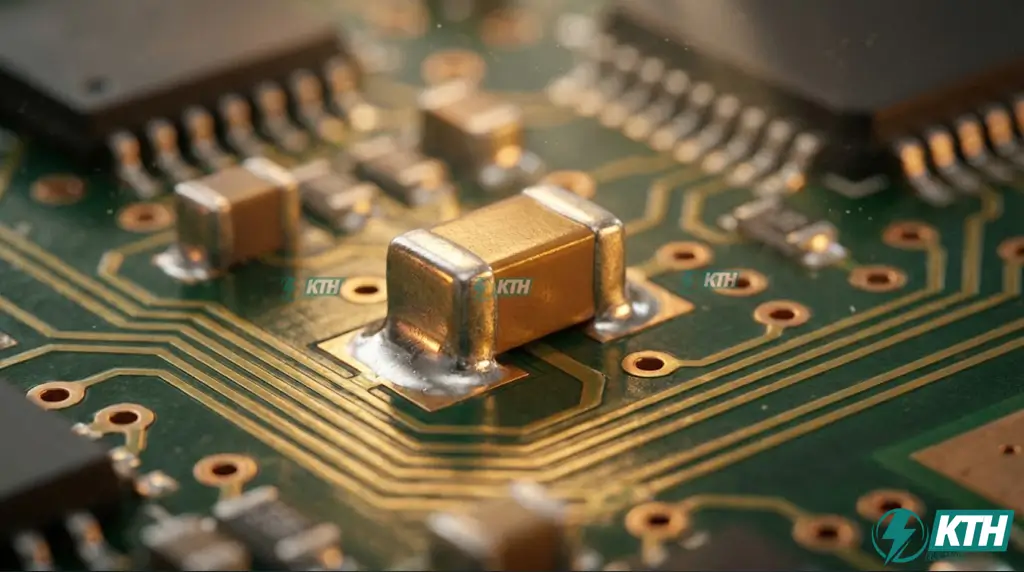
The most common capacitor in the world. It consists of alternating layers of metal and ceramic dielectric.
- Forms: Disc (Through-hole) and MLCC (Multi-Layer Ceramic Chip – SMD).
- Classes:
- Class 1 (e.g., C0G/NP0): extremely stable, low loss, used in oscillators.
- Class 2 (e.g., X7R, X5R): Higher capacitance, temperature sensitive, used for decoupling.
3.2.2 Mica Capacitors
- Dielectric: Mica (Silver Mica is the modern standard).
- Characteristics: Extremely stable, high precision ($\pm 1\%$), high voltage handling.
- Usage: High-frequency RF broadcast transmitters and precision calibration standards.
3.2.3 Film Capacitors
These use plastic films as dielectrics. They are known for their reliability and self-healing property (if a breakdown occurs, the metallization vaporizes to isolate the fault). These are often critical components in equipment requiring inverter maintenance and repair.
Common Dielectric Materials:
| Dielectric Type | Characteristics | Typical Application |
|---|---|---|
| Polyester (Mylar) | High dielectric constant, moisture resistant, low cost. | General purpose, DC blocking. |
| Polypropylene (PP) | Very low loss, high voltage handling. | Induction heating, AC motor run, Pulse circuits. |
| PTFE (Teflon) | High-temperature stability ($200^\circ C$), low loss. | Aerospace, Military. |
| Polycarbonate | Excellent temperature stability. | Timing circuits, precision filters. |
Part 4: Variable & Miscellaneous Capacitors
4. Variable Capacitors
💡 Direct Answer:
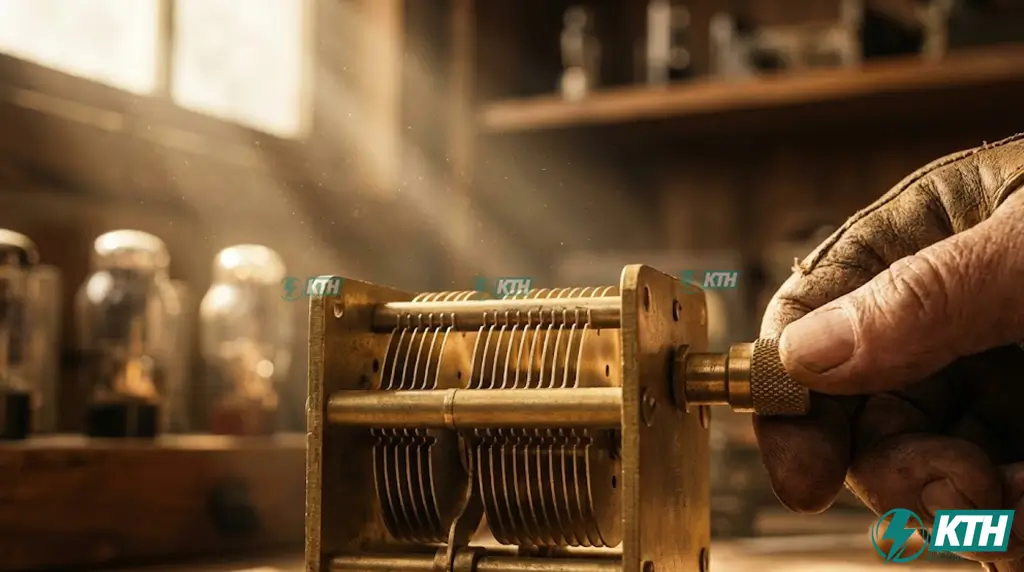
Variable capacitors allow the capacitance value to be adjusted dynamically (either mechanically or electronically). They are essential for tuning circuits (radios) and calibration.
Used when the capacitance needs to be tuned dynamically (like tuning a radio station).
4.1 Mechanically Controlled
- Tuning Capacitors: Large, robust air-dielectric capacitors. A knob rotates the rotor plates between stator plates to vary the overlapping area.
- Trimmer Capacitors: Small, set-and-forget devices on PCBs. Adjusted with a screwdriver for calibration.
4.2 Electrically Controlled
Varactor Diode (Varicap): A diode operated in reverse bias. Increasing the reverse voltage widens the depletion region, decreasing capacitance. Used in Voltage Controlled Oscillators (VCO) and PLLs.
5. Applications of Capacitors (Cheat Sheet)
To help you choose the right capacitor, here is a quick application guide. Correct selection is vital for system reliability, which we verify during our electrical system assessment.
| Application | Function | Recommended Capacitor Type |
|---|---|---|
| Power Supply Smoothing | Reduces ripple from rectifier output. | Aluminum Electrolytic (Bulk) |
| Decoupling / Bypass | Removes high-frequency noise from power pins. | Ceramic (MLCC) |
| Timing Circuits | Controls charging/discharging time constant ($T=RC$). | Film (Polyester) or Tantalum |
| Motor Starting | Creates phase shift to start AC motors. | Non-polar Electrolytic or Polypropylene |
| Radio Tuning | Adjusts resonant frequency of LC circuits. | Variable Air or Ceramic Trimmer |
| Signal Coupling | Blocks DC, passes AC signals. | Film or Electrolytic |
| Energy Storage | Back-up power for memory/RTC. | Supercapacitor |
6. Miscellaneous & Obsolete Types
- Integrated Capacitors: Built directly inside ICs using metal-oxide-semiconductor layers. These concepts are foundational to modern IoT (Internet of Things) devices.
- Vacuum Capacitors: High power RF transmission (transmitters).
- Leyden Jars: The historical ancestor of capacitors (Obsolete).
- Paper Capacitors: Largely replaced by modern plastic film types due to moisture absorption issues.
Final Expert Tip
When selecting a capacitor, don’t just look at Capacitance. Always consider the Voltage Rating (derate by 20-50% for safety), ESR (lower is better for power supplies), and Temperature Coefficient (critical for outdoor/automotive use). This attention to detail is vital in comprehensive maintenance, such as transformer maintenance.
For more tutorials on testing and using these components, check out our guide on How to Test a Capacitor.