

Comprehensive Guide to DC Machines: Construction, Working, Types & Applications
Part 1: Introduction & Working Principles
What is a DC Machine?
💡 Quick Summary: A DC machine is an electromechanical energy conversion device. It functions as a DC Motor when converting electrical energy into mechanical energy, and as a DC Generator when converting mechanical energy into electrical energy.
Electrical machines are categorized into AC and DC machines based on their source of supply. A DC machine is an electromechanical device designed to convert electrical energy into mechanical energy or vice versa.
- DC Motor: A machine used to convert electrical energy into mechanical energy.
- DC Generator: A machine used to convert mechanical energy into electrical energy.
It is important to note that the same physical machine can function as either a motor or a generator, as their construction is identical. For detailed diagnostics of such machinery, consider our electrical system assessment services.
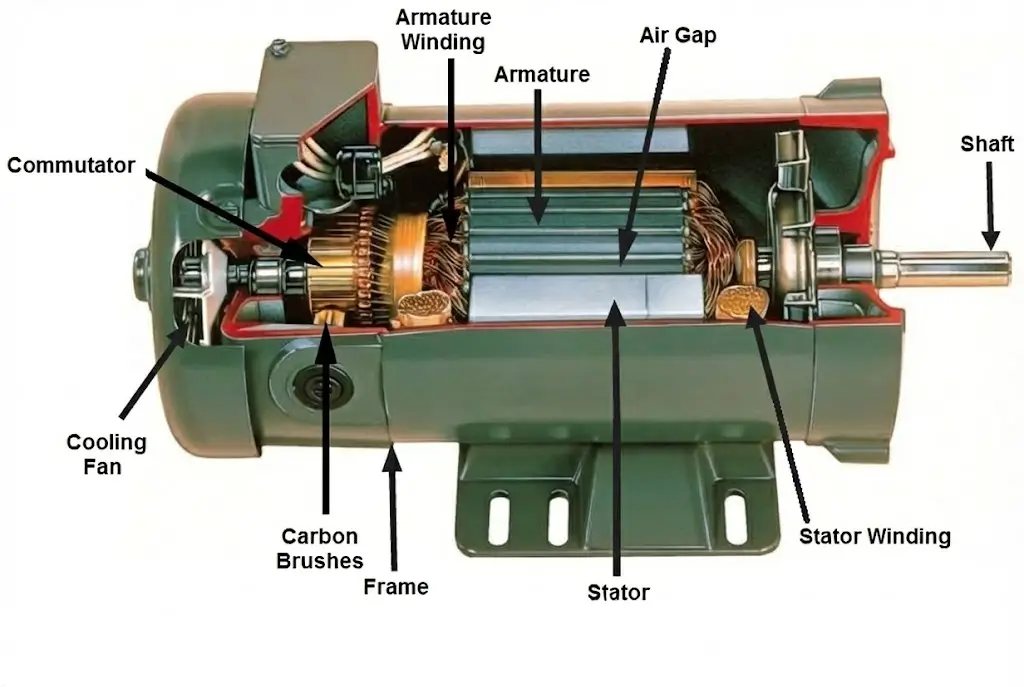
[Image of cutaway view of DC machine]Working Principle
💡 Core Concept: The operation relies on the physical principle that a current-carrying conductor placed in a magnetic field experiences a mechanical force (Lorentz force). The direction of this force is determined by Fleming’s Left-Hand Rule.
The operation of a DC machine relies on the effect that occurs when a current-carrying conductor coil is placed within a magnetic field. The magnetic field exerts a mechanical force on the coil, creating torque that rotates the conductor coils.
The direction of this torque is determined by Fleming’s Left-Hand Rule.
Force Equation:
$$F = BIL$$
F = Magnitude of the generated force
B = Flux density
I = Current
L = Length of the conductor
Part 2: Detailed Construction
Construction of a DC Machine
💡 Key Components: A DC machine consists of a stationary part (Stator) including the Yoke, Poles, and Field Winding, and a rotating part (Rotor) comprising the Armature Core, Armature Winding, Commutator, and Brushes.
A DC machine is composed of several stationary and rotating parts, including the yoke, poles, armature, and commutator.
1. Yoke (Frame)
The yoke, or frame, protects the internal components of the machine. It provides a low reluctance path for the magnetic flux to complete its circuit. While generally made of iron because it is cost-effective, it can also be made of silicon steel.
2. Pole and Pole Shoe
Poles provide housing for the field winding and generate magnetic flux within the machine. The pole shoes support the field winding to prevent it from slipping and help expand the flux throughout the machine. To reduce eddy current losses, poles and pole shoes are typically laminated, though small machines may use thin cast steel.
3. Field Winding
This winding is wound around the pole and excited by an external DC source or the machine’s output. When DC current flows through the coil, it generates an electromagnetic field (EMF) that magnetizes the pole. The winding is usually copper, though aluminum is used when cost is a factor.
4. Armature Core
The armature core is a cylindrical, rotating part connected to the shaft. It is made of high permeability, low reluctance materials like cast iron or steel and is laminated to reduce eddy currents. The outer periphery contains slots to house the armature winding, and holes are provided to release heat. Ensuring these components are free from partial discharge is crucial, which can be monitored via online partial discharge measurement service.
5. Armature Winding
Placed in the armature slots, this copper winding links with magnetic flux to induce rotating magnetic flux. There are two connection types:
- Lap Winding: Conductors are grouped by the number of poles (P), with parallel paths (A) equal to P. This provides more parallel paths, making it suitable for low voltage, high current applications.
- Wave Winding: Conductors form a single loop with the number of parallel paths always equal to two, regardless of pole count. This is used for high voltage, low current machines.
6. Commutator
Mounted on the shaft, the commutator connects the rotating armature conductors to the stationary external circuit. It acts as a rectifier, converting alternating torque in the armature into unidirectional (DC) torque. It consists of hard-drawn copper segments insulated by mica, paper, or plastic to reduce wear.
7. Brushes
Rectangular brushes, held against the commutator by springs, carry current from the armature conductors to the external circuit. They are typically made of carbon for small machines and electro-graphite for large machines.
8. Shaft and Bearings
The shaft transfers mechanical power: from motor to load (DC motor) or from prime mover to machine (DC generator). Bearings (ball or roll type made of carbon steel) are used at the shaft ends to reduce friction between rotating and stationary parts. Proper lubrication and alignment are part of essential motor monitoring solutions.
Part 3: Classification & Excitation Methods
Classification of DC Machines
💡 Types Overview: DC machines are primarily classified by field excitation into Separately Excited (external source) and Self-Excited. Self-excited machines are further divided into Series, Shunt, and Compound based on winding connections.
DC machines are classified based on their field excitation methods.
1. Separately Excited DC Machine
The field winding is physically and electrically separate from the armature winding and is supplied by a separate power source.
2. Self-Excited DC Machine
The field and armature windings are interconnected. These are further classified by their connection type:
- Series Wound: The field winding is connected in series with the armature. The entire high load current passes through the field winding, so it is designed with a few turns of thick wire.
- Shunt Wound: The field winding connects in parallel with the armature, receiving full voltage. It carries a very small current (approx. 5% of rated armature current) and uses many turns of thin wire to create high resistance.
- Compound Wound: Uses both series and parallel field windings.
- Short Shunt: Field winding is parallel only to the armature winding.
- Long Shunt: Field winding is parallel to the combination of the series field and armature windings.
Part 4: Applications in Industry
Applications
💡 Usage: DC machines are versatile, used in heavy traction (Series), constant speed lathes (Shunt), and applications requiring high starting torque with stability (Compound). They are also essential in electrolytic processes and welding.
DC machines are utilized in welding, electrolytic processes, variable-speed drives, and as control devices for sensing and tracking. In modern setups, they are often integrated with IoT systems; learn more about this in our article on What is IoT (Internet of Things).
DC Motor Applications
- Series Motor: Used where high starting torque and speed variation are needed (e.g., Cranes, Air Compressors, Traction systems, Vacuum cleaners).
- Shunt Motor: Used for constant speed applications where high starting torque is not critical (e.g., Fans, Lathes, Centrifugal pumps, Lifts).
- Compound Motor: Used where high starting torque combined with constant speed is required (e.g., Elevators, Rolling mills, Presses).
DC Generator Applications
- Separately Excited: Used for laboratory testing due to their wide voltage range and as a supply for DC motors.
- Shunt-Wound: Used for battery charging, lighting, and providing excitation to alternators.
- Series-Wound: Used in locomotives for regenerative braking and field excitation, and as boosters in distribution power systems.
For maintenance of related high-voltage equipment, check our transformer maintenance and transformer oil filtration services. To further your knowledge, you might also find our guide on Top 7 Essential Books for Electricians 2025 useful. Additionally, for practical skills, see How to Test a Capacitor.