

How to Wire a 30A – 250V, NEMA 6-30 Receptacle
How to Install a NEMA 6-30 (30A – 250V) Receptacle with 2P Breaker & GFCI Protection for EVs & Heavy-Duty Appliances
“A NEMA 6-30R is a 30-amp, 2P, 3W, 250V receptacle designed for heavy-duty 240V applications like welders and EV chargers. It utilizes two hot wires and one ground, with no neutral connection.”
A NEMA 6-30R is a 30-amp, 2P, 3W, 250V receptacle commonly used for high-power 240V appliances. It has two hot connections and an equipment grounding conductor but no neutral connection. This receptacle type is designed for heavy-duty applications such as welders, generators, large appliances, and certain EV charging stations.
A NEMA 6-30 outlet can handle 30 amps at 250 volts on a single-phase power supply. The industrial-grade 30-amp version is suitable for high-wattage industrial and residential equipment, including welders, generators, electric ranges, air compressors, and some Level 2 electric vehicle (EV) chargers.
In the following wiring tutorial, we will demonstrate how to wire a NEMA 6-30 receptacle using both standard and GFCI breakers. The wiring diagrams will also show the correct breaker and wire size for safely powering 30-amp receptacles used with high-wattage appliances and EV charging.
The NEMA 6-30 Receptacle
The NEMA 6-30R is a 250V receptacle without a neutral connection. It is designed for use with a matching 6-30P plug. As the name suggests, the “30” in 6-30R indicates the maximum current rating of 30 amperes, while the “R” stands for Receptacle (outlet). Similarly, the “P” in 6-30P stands for Plug, with “30” again denoting the maximum current rating.
The NEMA 6-30 configuration uses a 2-pole, 3-wire system for 240V appliances. This way, it does not require a neutral wire. It has two hot slots (Hot 1 and Hot 2) and one grounding slot for the equipment grounding conductor (EGC).
Terminals
“A NEMA 6-30 receptacle features three specific terminals: The Green Screw (G) for Ground, the Brass Screw (X) for Hot 1, and the Brass Screw (Y) for Hot 2.”
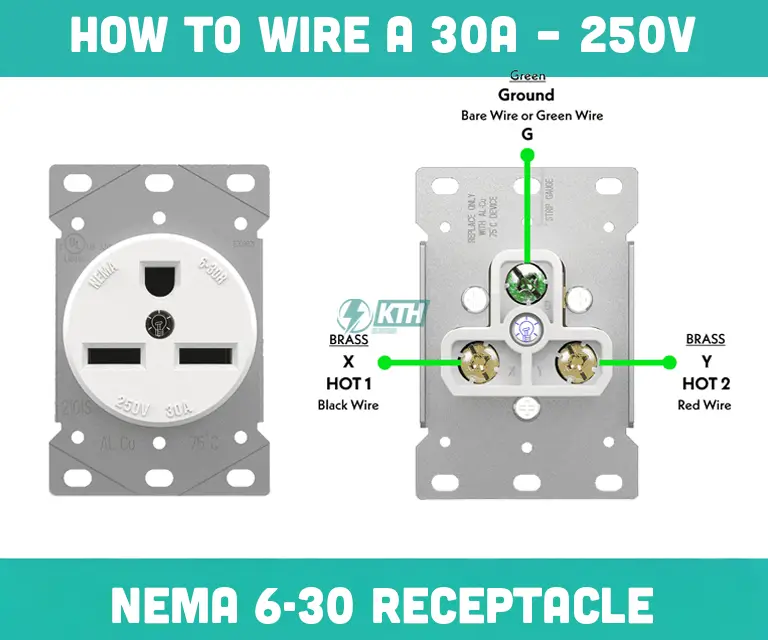
There are three terminals in a 6-30 receptacle:
G Terminal
Green Screw: Connects to Equipment Grounding Conductor (EGC) – Bare or Green wire.
X Terminal
Brass Screw: Connects to HOT 1 (Line 1) – Black Wire.
Y Terminal
Brass Screw: Connects to HOT 2 (Line 2) – Red Wire.
Electrical Ratings & Specifications
| Feature | Specification |
|---|---|
| Poles | 2-Pole, 3-Wire – Grounding – No Neutral |
| Voltage | 250V Single-Phase AC Supply – 60 Hz |
| Breaker / GFCI | 30A |
| Current | 24A (Continuous) – 30A (Max) |
| Wattage | 7,200 W |
| Wire Size | #10 AWG (Copper Only) |
| Temp. Rating | -40°C to 75°C (-40°F to 167°F) |
| Dielectric-strength | Withstand 2kV |
| Grade & Material | Industrial Grade – Thermoplastic/Composite & Galvanized Steel |
| Mounting | Flush / Screw Mounting |
| Outdoor Box | 2-gang outdoor box – NEMA 3R rainproof enclosure |
| Wiring | Hardwired / Dedicated Circuit |
Good to Know:
For EV charging, it is recommended to use industrial-grade and EV-rated outlets instead of standard outlets and receptacles. This is because, according to the NEC 80% continuous load rule, a standard 30A outlet is rated for a maximum of 24A continuous load. In contrast, an industrial-grade outlet is designed to safely handle the full 30A continuous load for extended periods (such as during EV charging) without overheating or degrading over time.
Wiring NEMA 6-30 Receptacle with a 2P GFCI
“A 30-amp outlet for EV charging must be protected by a 30A GFCI breaker if ground-fault protection is not already built into the EV charger, especially for outdoor or garage installations.”
A NEMA 6-30 receptacle for electric vehicle (EV) charging can be installed as either a plug-in outlet or a hardwired connection. The 30-amp outlet must be protected by a 30A GFCI breaker if ground-fault protection is not already built into the EV charger.
Wiring Instructions (as shown in the diagram):
- Connect the two hot wires (Hot 1 – black and Hot 2 – red) from the 2-pole, 30A GFCI breaker to the X and Y terminals of the NEMA 6-30 receptacle.
- Connect the ground wire (bare copper or green/yellow) to the G terminal of the receptacle.
- For proper operation, connect the white pigtail wire from the GFCI breaker to the neutral busbar in the 120/240V main panel.
- Although a NEMA 6-30 receptacle can accept conductor sizes from #12 AWG to #4 AWG, the recommended wire size for this application is typically #10 AWG copper (or #8 AWG if required by derating or longer runs).
- For outdoor installations, use a NEMA 3R weatherproof (rainproof) 2-gang enclosure to ensure protection against moisture and environmental exposure.
Good to Know:
- NEC Article 625.54 requires that all receptacles installed for the connection of Electric Vehicle Supply Equipment (EVSE) must have ground-fault circuit interrupter (GFCI) protection.
- According to NEC 210.8(A)(1)–(A)(11), outdoor receptacles must be installed downstream of a GFCI breaker or device, in accordance with Articles 426.28 or 427.22.
- Per NEC 625.41, each EV charging outlet must be supplied by a dedicated branch circuit with no other outlets connected.
- Required by NEC – 625.54, receptacles installed for the connection of electric vehicle supply equipment (EVSE) must be GFCI protected for personnel.
- Using both a GFCI breaker and a GFCI-protected EV charger may cause nuisance tripping. In such cases, only one level of GFCI protection should be used (breaker or EVSE), as permitted by code.
The following wiring diagram illustrates the proper installation of a NEMA 6-30R, 30-amp industrial-grade receptacle using a 2-pole, 30A GFCI breaker.
(Click image or open in a new tab to enlarge)
Wiring NEMA 6-30 Receptacle with a 2P Breaker
“A standard 2-pole 30A breaker is often preferred for NEMA 6-30 installations for indoor dry locations or when the appliance (like a modern EV charger) already has built-in GFCI protection to prevent nuisance tripping.”
The wiring configuration for a NEMA 6-30 receptacle with a 30A, 2-pole standard breaker is the same as when using a 2-pole GFCI breaker.
A standard breaker is often preferred for this installation because it helps prevent nuisance tripping, particularly when the EV charger or appliance already includes built-in GFCI protection (as is common with most modern EV chargers).
The following wiring diagram illustrates how to properly connect a NEMA 6-30, 30-amp receptacle using a 2-pole, 30A standard breaker for commercial and residential 240-volt applications, such as space and garage heaters, EV charging, HVAC systems, RVs and other high-power appliances.
(Click image or open in a new tab to enlarge)
Frequently Asked Questions (FAQs)
Should I Use a GFCI or Standard Breaker with NEMA 6-30 Receptacle?
“You should use a standard 2-pole 30A breaker unless your local electrical code requires GFCI protection (e.g., garages, outdoors, basements) or for EV charging stations per NEC 625.54.”
You should use a standard 2-pole 30A breaker unless your local electrical code requires GFCI protection. Many EV chargers already have built-in GFCI protection, and double protection can cause nuisance tripping. If GFCI is required by NEC (e.g., in garages or outdoors), use a 2-pole 30A GFCI breaker.
NEC 210.8(A & B) now requires GFCI protection for 250V, 50A or less receptacles installed in, garages outdoors, basements, laundry areas, accessory buildings with a floor at/below grade not intended as habitable rooms.
That means if your NEMA 6-30R is in any of those locations, you must use a GFCI breaker (or GFCI receptacle – though GFCI receptacles for 6-30 are rare).
If the receptacle is in a dry indoor location (utility room, mechanical room, workshop) and not subject to the above, a standard 30A breaker is acceptable.
How Many Amps Can 30A, 6-30R Handle Safely?
“A NEMA 6-30 receptacle handles a maximum of 30 amps for non-continuous loads, but must be derated to 24 amps (80%) for continuous loads running 3 hours or more.”
A NEMA 6-30 receptacle is rated for a maximum of 30 amps. For continuous loads (defined as 3 hours or more, such as EV charging), the NEC requires derating to 80% of the breaker rating (often referred to as the 125% rule), as specified in NEC 210.19(A)(1) and 210.20(A). This limits the allowable continuous current to:
- Continuous Load: 30A × 80% = 24A
- Non-Continuous Load: Up to 30A
An industrial-grade 30A receptacle, however, is designed to safely handle a full 30A continuous load for extended periods without overheating or deterioration, making it suitable for demanding applications such as EV charging.
These ratings comply with NEC 210.19(A)(1), 215.2, 230.42(A) for continuous and non-continuous load calculations, as well as 110.14(C) for temperature considerations.
Which Breaker Size is Suitable for 6-30 Receptacle?
“The suitable breaker size for a NEMA 6-30 outlet is a 2-pole, 30A breaker (standard or GFCI) at 240V, sized at 125% of the continuous load.”
For continuous loads, the NEC requires applying the 80% rule, meaning only 80% of the breaker’s rated capacity should be used for a load that runs for 3 hours or more. In addition, the overcurrent protection device (OCPD) i.e. fuse or circuit breaker must be sized at 125% of the continuous load.
According to NEC Table 210.21(B)(3), a 30-amp receptacle may serve a 30-amp branch circuit. Therefore, based on NEC 210.19(A)(1) and 210.20(A), the suitable breaker size for a 30A outlet (NEMA 6-30) is a 2-pole, 30A breaker or 30A GFCI breaker at 240V.
How Many Watts Can a 30A, 6-30 Receptacle Hold?
“At 240V, it can supply a maximum of 7,200 watts, or 5,760 watts for continuous loads (80% rule).”
At 240V, a 30A outlet can supply:
- Maximum: 30A × 240V = 7,200 watts
- Continuous load (80% rule): 24A × 240V = 5,760 Watts
What is the Correct Wire Size and Cable Type to Use with NEMA 6-30 Receptacle?
“The standard wire size is #10 AWG copper, typically utilizing 10/2 NM-B (Romex) for indoor use or THHN/THWN in conduit.”
Wire Size: As stated earlier, a 30-amp outlet can be used for 24A continuous loads and 30A non-continuous loads (while an industrial-grade outlet can safely handle a full 30A continuous load).
For this ampacity, #10 AWG copper conductors are typically used and can carry:
- 30A at 60 °C (140 °F)
- 35A at 75 °C (167 °F)
- 40A at 90 °C (194 °F)
This makes #10 AWG copper the standard wire size for a NEMA 6-30 receptacle, in compliance with NEC Table 310.16 and CEC Table 2.
For an added margin of safety (especially for long runs or high ambient temperatures) #8 AWG copper may be used with a 30A NEMA 6-30 receptacle.
Similarly, for a circuit protected by a 30A overcurrent protective device (OCPD), the equipment grounding conductor (EGC) can be #10 AWG copper, as specified in NEC Table 250.122.
Cable Types:
- Indoor, Dry Location (Romex): 10/2 – NM-B
- Conduit (Indoor or Outdoor): THHN/THWN (in EMT, PVC, etc.).
- Outdoor Direct Burial: 10/2 – UF-B
- Flexible Connection: 10/3 – SOOW or SJEOOW – (For short, flexible cord or portable equipment)
Can You Install NEMA 6-30R in 120V AC Circuit?
“NO – NEMA 6-30R is strictly designed for 240V applications (two hot legs). Installing it on 120V is a dangerous code violation.”
NO – NEMA 6-30R is specifically designed for two 120V hot legs that are 180° out of phase to provide 240–250V between them.
While technically possible, but you should NOT install a NEMA 6-30R on a 120V AC circuit. This is because a user could later plug in a 240V appliance in this 120V outlet expecting full voltage, which could cause the appliance to draw excessive current or fail to start properly.
Moreover, NEC 406.4(A) & 406.4(A) prohibit installing receptacles that are not properly rated for the circuit’s voltage.
If you need a 30A receptacle for 120V loads, use a NEMA 5-30R (30A, 125V, Hot + Neutral + Ground) or wire NEMA TT-30 for travel trailer and RVs.
Instructions, Precautions & Codes
- If your primary purpose for installing a NEMA 6-30 receptacle is EV charging, use an industrial-grade, EV-rated receptacle and consider hardwiring the charger instead of relying on a plug-in connection.
- A NEMA 6-30R should not be installed in a single-gang wall box. Instead, use a two-gang outdoor box with a NEMA 3R rainproof enclosure, especially for outdoor installations.
- According to NEC Table – 310.16 and 24(1), the correct breaker and wire size for a 30-amp, 6-30 receptacle is #10 AWG copper.
- Use #10/2 cable (two hot conductors and one ground) for a 240V, 30A breaker and receptacle.
- A standard 30A outlet can safely support 24A continuous load (per NEC 210.19(A)) and 30A non-continuous load (per NEC 215.2 and 230.42(A)). However, an industrial-grade outlet can be used for a full 30A continuous load.
- For longer runs exceeding 50 ft (15.25 m), upgrade to a larger wire gauge to compensate for voltage drop.
- According to NEC 310.16, add approximately 20% additional ampacity for every 100 ft (30.5 m) of circuit length (e.g., between the main panel and a subpanel). For distance and ambient temperature adjustments, refer to NEC 110.14(C), 310.15(B)(2), 310.16, and 240.4(A).
- It is a code violation to draw 30A from a 30A outlet when the breaker is rated 20A or 25A. Similarly, It against code to Use undersized conductors (e.g., 12 AWG or 14 AWG) on a 30A breaker.
- A 30A, 240V receptacle must be installed on a 30A breaker or GFCI breaker. In addition, it must used as a dedicated circuit for a single load, especially for EV charging (per NEC 625.41).
⚠️
Critical Safety Warning
Always disconnect power by switching OFF the breaker at the main service panel before performing any electrical system assessment or work.
If you are not confident or qualified, consult a licensed electrician to ensure the installation is performed safely and complies with local electrical codes.
The author assumes no responsibility for any losses, injuries, or damages resulting from the use or misuse of the information provided. Electricity is extremely dangerous – exercise extreme caution and never attempt wiring unless you fully understand the process.