

How to Wire NEMA TT-30 Receptacle for RVs: The Definitive 120V Guide
Introduction: The “One-Second” Mistake That Costs Thousands
“Connecting a 120V NEMA TT-30 RV plug into a 240V circuit is the most common and destructive error. The NEMA TT-30 configuration is exclusively 120 Volts. Miswiring it like a dryer outlet will instantly destroy converters, appliances, and control boards.”
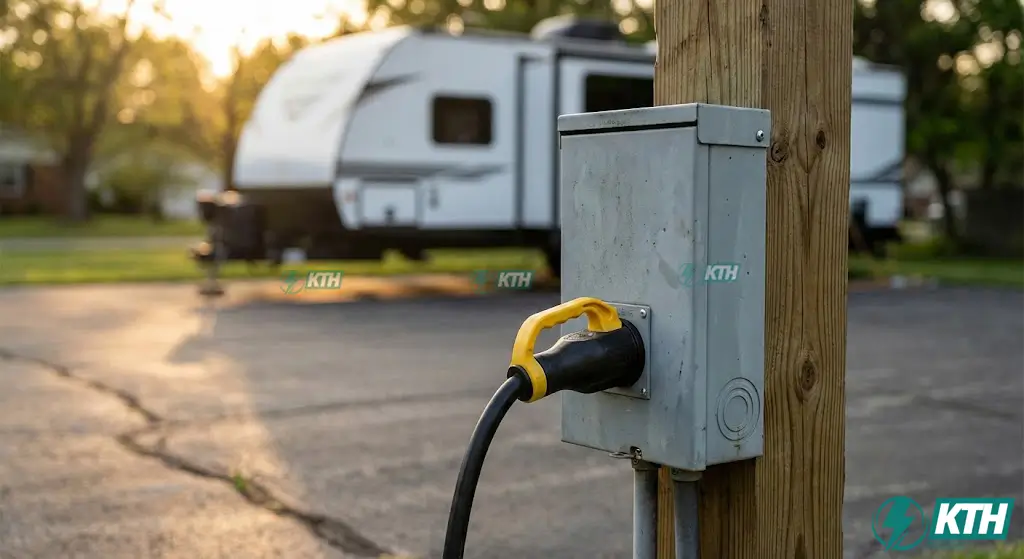
Imagine this scenario: You’ve just finished building a parking pad for your new travel trailer. You spent the weekend digging a trench, laying conduit, and wiring up a shiny new 30-amp outlet so you can run the AC while packing for your trip. You plug in the RV shore power cord. Instantly, you hear a loud pop from inside the camper, followed by the acrid smell of burning electronics.
In less than one second, you fried your microwave, your television, your converter, and your air conditioner control board.
Why? Because you wired it like a dryer.
As Electrical Engineers at KTH Electric Co., Ltd., we see this tragedy happen far too often during our electrical system assessments. There is a persistent, dangerous myth among DIYers that “30 Amps means 240 Volts” or that an RV plug is the same as an old electric dryer outlet. It is not.
The NEMA TT-30 configuration is exclusively 120 Volts.
This guide is designed to walk you through the precise, code-compliant method for installing a 30 Amp RV receptacle (NEMA TT-30R). We will strip away the confusion, focus heavily on safety, and ensure that when you plug your rig in, the only thing that runs is your refrigerator—not your repair bill.
!C1: CHALLENGE & CONTEXT (Safety Criticals)
The “Dryer Outlet” Myth: 120V vs. 240V
“Stop immediately if you are using a Double-Pole breaker. RVs (30 Amp) run on 120V and require a Single-Pole breaker. Dryers run on 240V and use Double-Pole breakers. Feeding 240V to an RV is a catastrophic error.”
Before we pick up a wire stripper, we must address the physics. In North American residential electrical systems, high-demand appliances (Dryers, Ranges, Welders) typically use 240 Volts. These use a Double-Pole Breaker which occupies two slots in your panel, pulling from both Hot Busbar A and Hot Busbar B.
Your RV is different.
Most travel trailers and Class C motorhomes with 30-amp service run on 120 Volts AC. They require a Single-Pole Breaker (one slot).
Two Hots (240V) + One Neutral.
DO NOT USE.
Two Hots (240V) + Neutral + Ground.
DO NOT USE.
One Hot (120V) + One Neutral + One Ground.
THIS IS THE STANDARD.
If you feed 240 volts into a system designed for 120 volts, the voltage will force itself through components that cannot handle the pressure, destroying them instantly.
Understanding the NEMA TT-30R Configuration
To wire this correctly, you must understand the terminology. If you are unsure about the difference between these terms, please read our guide on Socket vs Outlet vs Receptacle to clarify the language used in this tutorial.
For the NEMA TT-30R (“TT” stands for Travel Trailer):
- 1.
The Ground (Green/Bare): This connects to the round or U-shaped pin at the top. It is your safety line, directing stray current to the earth to prevent shock. - 2.
The Neutral (White): This connects to the bottom-left slot (looking at the receptacle face). It carries the current back to the panel to complete the circuit. - 3.
The Hot (Black): This connects to the bottom-right slot. It supplies the 120V potential from the breaker.
Engineering Spec Sheet
🛠️ C2: CORE SOLUTION (Execution & Engineering)
Phase 1: Essential Materials & Tools Checklist
“You need 10 AWG Copper Wire (10/2 NM-B for indoor, 10/2 UF-B for outdoor), a NEMA TT-30R receptacle, and a brand-specific 30 Amp Single-Pole Breaker. Never mix breaker brands.”
You cannot perform a professional-grade installation with amateur-grade tools. Here is the exact bill of materials (BOM) we recommend.
1. The Conductors (Wire)
For a 30-amp circuit, the National Electrical Code (NEC) dictates the use of 10 AWG (American Wire Gauge) Copper wire.
- Indoor Run: Use 10/2 NM-B (Romex). Contains Black, White, and Bare wires.
- Outdoor/Underground: Use 10/2 UF-B or THWN in PVC conduit. NM-B cannot be used outdoors.
2. Receptacle & Box
Receptacle: NEMA TT-30R. Ensure UL-listed (Bryant, Eaton, Leviton).
Enclosure: For outdoors, use a NEMA 3R Weatherproof Box with a “bubble cover” to keep connections dry during rain.
3. The Circuit Breaker
You need a 30 Amp Single-Pole Breaker.
Crucial: Breakers are not universal. If you have a Square D “Homeline” panel, use a Square D Homeline breaker. Mixing brands violates UL listing.
For a deeper dive into protection mechanics, review our technical article on Overload Relays and Trip Curves.
4. The Engineering Toolbag
- Multimeter: Non-negotiable.
- Torque Screwdriver: Essential to prevent arcing. In our electrical system maintenance services, we verify torque specs meticulously.
- Wire Strippers: For 10 AWG solid wire.
- Voltage Tester: For safety.
Phase 2: Planning the Circuit & Voltage Drop Calculation
The 3% Voltage Drop Rule
The NEC recommends a max voltage drop of 3%. If voltage drops below 108V, your RV’s AC compressor may seize. Distance matters.
Before drilling, we must calculate Voltage Drop. Copper wire has resistance. The longer the wire, the more voltage is lost as heat before it reaches your RV.
- 0-50 Feet
10 AWG Copper: Perfectly fine. - 50-100 Feet
Danger Zone: 10 AWG might drop voltage too low under load. - Over 100 Feet
Upsize Required: Strongly recommend 8 AWG or 6 AWG wire.
*Engineering Note: If you upsize to 8 AWG, you will need a “pigtail” (short 10 AWG wire) at the receptacle end, as most TT-30R terminals do not accept 8 AWG.
Phase 3: Mounting & Preparing the Pedestal
24 inches depth for UF-B (Direct Burial) or 18 inches for PVC conduit.
Mount box at least 24 inches above grade to prevent splash-back.
Leave 8-12 inches of extra wire in the box for maneuvering.
Phase 4: Wiring the NEMA TT-30R Receptacle (The Crucial Step)
This is the moment where attention to detail prevents future fires.
Strip 4-6 inches of outer sheathing. Strip 5/8″ to 3/4″ of insulation from Black and White wires. Do not nick the copper.
Ground Connection
Connect Bare/Green wire to the Green Hex Screw.
Primary Safety Fail-safe
Neutral Connection
Connect White wire to the Silver Terminal (Bottom-Left slot).
Hot Connection
Connect Black wire to the Brass/Gold Terminal (Bottom-Right slot).
Hand-tightening is rarely enough. Use a torque screwdriver to hit 25-30 inch-pounds. Loose connections create “hot spots” that we frequently identify using Thermal Scan Electrical Cabinet Services.
Phase 5: Termination at the Breaker Panel
⚠️ WARNING: High Voltage Risk
Working inside a breaker panel is inherently dangerous. If you are uncomfortable, Contact Us or a local electrician immediately.
- Cut the Power: Turn off the Main Breaker. Verify with a voltage tester.
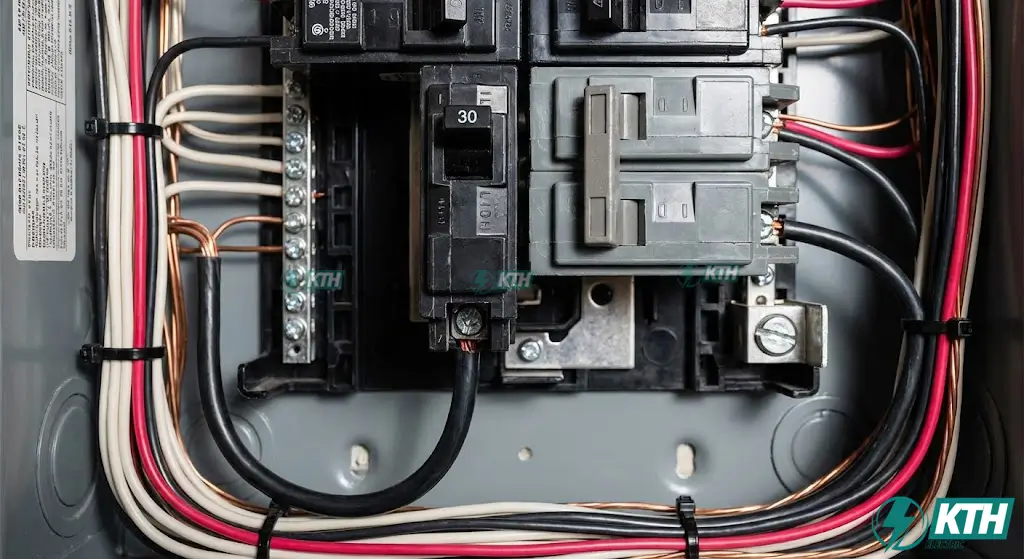
- Route the Wire: Route wires neatly along the gutters of the panel. A messy panel is a dangerous panel; proper wire management is a standard part of our Low Voltage Electrical Cabinet Maintenance.
- Connect Ground: Bare wire to the Ground Bus Bar.
- Connect Neutral: White wire to the Neutral Bus Bar. Ensure it is firmly seated to prevent “open neutral” issues.
- Connect Hot: Insert Black wire into the 30 Amp Single-Pole Breaker and torque it. Snap the breaker into the busbar.
🔍 C3: CONFIRMATION & CONCLUSION
Do not plug your RV in yet. We must perform the “Smoke Test” without the smoke.
The Verification Sequence
Flip Main Breaker ON. Flip the 30 Amp RV Breaker ON.
Set to AC Volts (V~).
Frequently Asked Questions (FAQ)
Q: Can I use a dryer outlet (NEMA 10-30) for my RV if I make an adapter?
A: NO. A dryer outlet provides 240V. Plugging a 120V RV into it will destroy your electrical system instantly.
Q: Do I need to drive a ground rod at the pedestal?
A: If it is a single branch circuit, the ground wire back to the main panel is usually sufficient. However, for sub-panels or extra lightning protection, a ground rod is recommended.
Q: Why does my breaker trip when I turn on the RV Air Conditioner?
A: This is often due to high “inrush current.” If the wiring is sound but the breaker trips, you may need to analyze the load or check the breaker’s condition. For complex tripping issues, refer to our insights on Overload Relays and Trip Curves.
Final Thoughts: Protect Your Investment
Wiring a NEMA TT-30 receptacle is straightforward if you respect the physics: One Hot, One Neutral, One Ground = 120 Volts.
Once your installation passes the multimeter test, we strongly recommend using an Electrical Management System (EMS). This acts as a gatekeeper, analyzing power quality before it enters your rig. If you require professional assistance with any electrical installation or system assessment, please visit our Home Page to see how KTH Electric can assist you.
Stay safe, follow the code, and enjoy your powered adventures!