
Knowledge
Solar Panels 2025: Costs, Tech & ROI Guide (Engineer Verified)
The Ultimate Guide to Solar Panels: Technology, Costs, and Installation (2025 Edition)
The Solar Energy Revolution in Vietnam
💡 Quick Insight
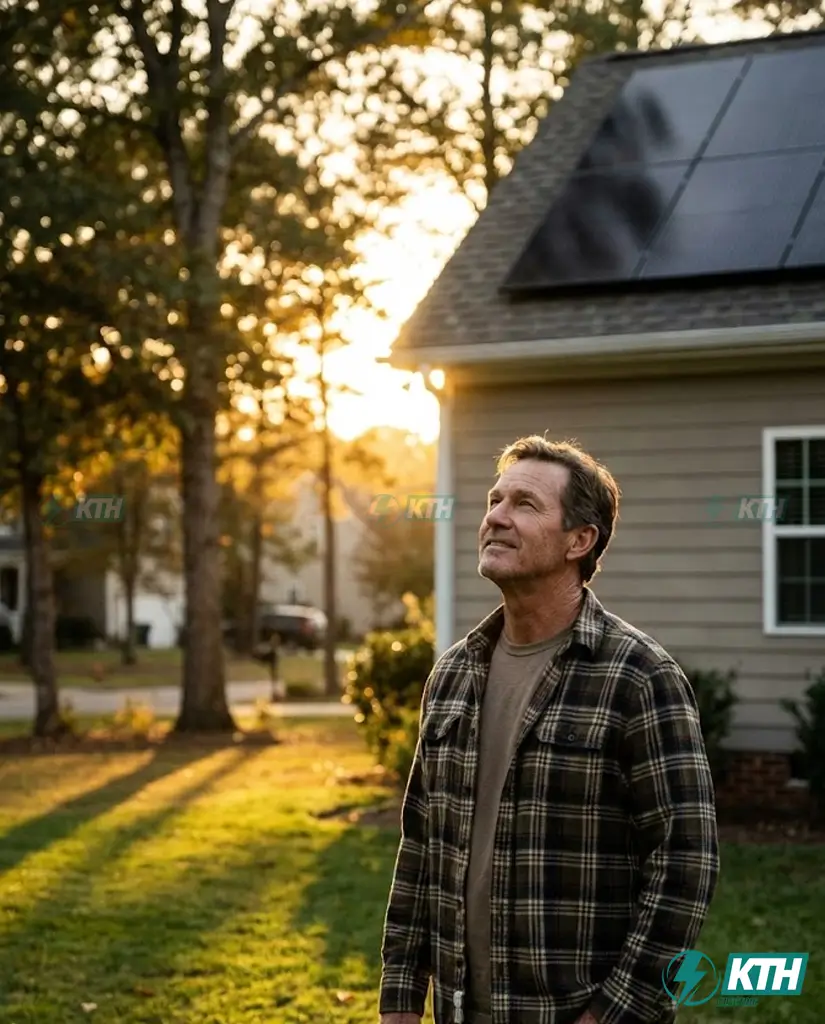
Vietnam is undergoing a rapid shift towards decentralized renewable energy. With rising EVN tariffs in 2025, solar power has transitioned from an alternative option to a primary financial strategy for cost reduction and energy independence.
Have you noticed more rooftops glinting in the sunlight lately? You aren’t imagining it. We are witnessing a quiet but powerful revolution in how we generate power. As an Electrical Engineer with over two decades of field experience, I’ve seen the industry evolve from clunky, expensive experimental setups to the sleek, high-efficiency photovoltaic modules we install today.
Current Energy Landscape and Electricity Price Trends
The days of cheap, unlimited electricity are behind us. With global energy volatility and the increasing demand placed on national grids—specifically regarding EVN (Vietnam Electricity) adjustments—homeowners and business owners are feeling the pinch. We are seeing a distinct trend: electricity prices are on an upward trajectory. This economic pressure is the primary driver pushing savvy property owners toward energy independence.
The Shift Toward Renewable Energy and Net Zero Goals
Beyond the wallet, there is the world. The push for “Net Zero” isn’t just government policy; it’s a technological imperative. Solar electric systems are no longer alternative energy; they are becoming the primary energy source for forward-thinking infrastructure. We are moving away from fossil fuel reliance toward a decentralized grid where you become the power plant.
Article Scope: From Technical Basics to Financial ROI
This guide isn’t just a brochure. It is a technical breakdown designed for decision-makers. We will strip away the marketing fluff and look at the engineering reality: how the photovoltaic effect works, the difference between monocrystalline and polycrystalline silicon, the truth about ROI (Return on Investment), and the critical importance of selecting the right inverter. Whether you are in North Carolina or Ho Chi Minh City, the physics of electricity remains the same.
What Are Solar Panels? Understanding Photovoltaic Technology
⚡ Technical Definition
A solar panel (PV module) converts sunlight into Direct Current (DC) electricity via the photovoltaic effect using semiconductor materials like silicon. It requires an inverter to convert this into usable Alternating Current (AC).
To make a smart investment, you need to understand what you are buying. A “solar panel” is technically known as a photovoltaic (PV) module. It is a packaged, connected assembly of solar cells.
The Photovoltaic Effect: How Sunlight Becomes Electricity
At its core, solar technology relies on the photovoltaic effect. When sunlight (photons) strikes a semiconductor material—typically silicon—it knocks electrons loose from their atoms. If conductors are attached to the positive and negative sides of a cell, it forms an electrical circuit. When electrons flow through such a circuit, they generate electricity.
Think of it like a stream of water. The sun provides the pressure (voltage) to push the water (current/amperage) through the pipe (wire). This raw energy is Direct Current (DC), which we then need to convert to Alternating Current (AC) for your home to use.
Anatomy of a Solar Module
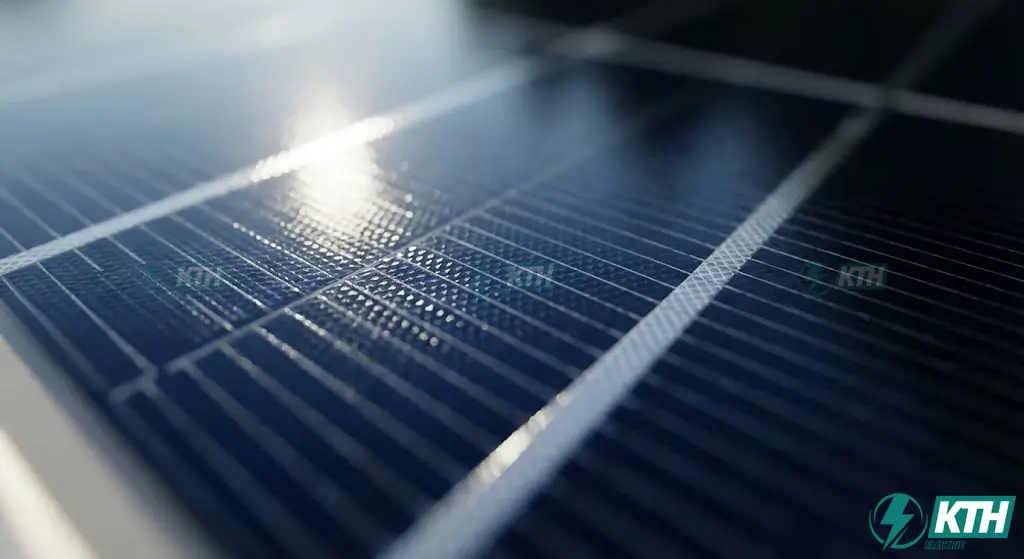
A solar panel is a sandwich of precision-engineered materials designed to withstand decades of harsh weather while generating power.
Solar Cells (Silicon Wafers)
The engine of the panel. These are usually made of crystalline silicon. High-end panels now use N-type cells or PERC (Passivated Emitter and Rear Cell) technology to capture more light.
Tempered Glass and Anti-Reflective Coating
The top layer is not just window glass. It is low-iron, tempered glass designed to be impact-resistant (think hail and debris). Crucially, it has an anti-reflective coating to ensure sunlight is absorbed, not bounced away.
Encapsulant (EVA)
The solar cells are fragile. We sandwich them in Ethylene-Vinyl Acetate (EVA), a transparent polymer that acts as a shock absorber and seals out moisture.
Backsheet
The rear defense layer. It protects the internal components from humidity and electrical isolation faults.
Aluminum Frame and Junction Box
The anodized aluminum frame provides structural rigidity for racking rails. The junction box (J-Box) on the back houses the bypass diodes—critical components that prevent power loss when part of the panel is shaded.
Types of Solar Panels: A Comparative Technical Analysis
Not all panels are created equal. In my 20 years of engineering, I’ve seen many homeowners buy “cheap” only to replace the system five years later. Here is the technical breakdown of what is available in 2025.
Monocrystalline Silicon Panels (Mono)
Currently the gold standard. You can identify them by their uniform dark black color and rounded edges.
- ✔ The Tech: Made from a single crystal structure of silicon. This purity allows electrons to move more freely, resulting in higher efficiency ratings (typically 20% to 23%).
- ✔ PERC Technology: Most modern Mono panels feature Passivated Emitter and Rear Cell technology. This adds a dielectric passivation layer on the rear of the cell, reflecting unabsorbed light back into the silicon for a “second chance” at absorption.
- ✔ Half-Cut Cell Design: You might notice panels that look like they are split in the middle. These “half-cut” cells reduce resistive losses and improve performance in partial shade. As an engineer, I highly recommend these for residential roofs.
Polycrystalline Silicon Panels (Poly)
Identifiable by their speckled blue color.
- ✘ The Tech: Made by melting many silicon fragments together. The resulting wafer has many boundaries that block electron flow, reducing efficiency (typically 15% to 17%).
- ✘ Verdict: While cheaper, they are becoming obsolete for residential use due to lower space efficiency. We rarely install these on modern homes anymore.
Bifacial Solar Panels (Double-Sided Power Generation)
A game-changer for ground mounts and flat roofs.
- ✔ The Tech: These panels capture sunlight on the front and reflected light (albedo) on the back.
- ✔ Application: If you have a white roof or a ground mount over light-colored concrete, bifacial panels can increase energy yield by 10-20% without taking up extra space.
| Feature | Monocrystalline (PERC/N-Type) | Polycrystalline | Bifacial |
|---|---|---|---|
| Efficiency | High (20-23%+) | Moderate (15-17%) | Very High (up to 27% total) |
| Space Required | Low | High | Low |
| Aesthetics | Sleek Black | Blue/Speckled | Translucent/Black |
| Heat Tolerance | Excellent | Good | Excellent |
| Cost | High | Low | High |
| Best For | Residential Roofs | Budget Projects | Commercial/Ground Mounts |
Top Solar Panel Brands Ranking in Vietnam & Global Markets (2025)
In the electrical engineering world, we look for “Tier 1” manufacturers. This isn’t just a marketing term; it refers to financial bankability (BloombergNEF standards), meaning the company is stable enough to honor its 25-year warranty.
1. Jinko Solar
A massive player globally and in Vietnam. Their Tiger Neo series (N-type) is a favorite among installers for its high efficiency and reasonable price point. They are robust and reliable.
2. LONGi Solar
The leader in Monocrystalline technology. LONGi focused exclusively on Mono while others were still making Poly. Their Hi-MO series is ubiquitous in commercial solar arrays due to its low degradation rate.
3. Canadian Solar
Do not let the name fool you; they are a global giant with massive manufacturing in Asia. Their panels are known for excellent “low irradiance” performance—meaning they wake up earlier in the morning and work later in the evening.
4. AE Solar (Germany)
German engineering is highly respected in Vietnam. AE Solar is famous for its “Hot-Spot Free” technology, which protects the panel from overheating if a single cell is shaded. This is a critical safety feature.
5. SunPower / Maxeon
The premium choice. If budget is secondary to performance, SunPower panels (Maxeon cells) offer the highest efficiency on the market. They use a unique copper backing that makes the cells nearly impervious to cracking.
Part 2
Engineering Analysis & Installation
Pros and Cons of Installing Solar Power Systems
Before we talk about drilling holes in your roof, let’s weigh the engineering reality against the benefits.
✅ Key Advantages
- Drastic Reduction in Monthly Electricity Bills: This is the obvious one. By generating your own kWh (kilowatt-hours), you pull less from the grid. With a properly sized system, you can offset 70-90% of your energy costs.
- Environmental Impact: A standard 5kW system prevents thousands of pounds of CO2 from entering the atmosphere annually. It is a tangible contribution to decarbonization.
- Durability and Warranty: Solar panels are solid-state technology with no moving parts. This is why manufacturers can offer 25 to 30-year performance warranties. They are built to survive hail, wind, and intense UV radiation.
- Passive Cooling: An overlooked benefit I often point out to clients: The panels absorb the sun’s heat that would otherwise bake your roof. We often see attic temperatures drop significantly after installation.
⚠️ Potential Drawbacks and Considerations
- High Initial Investment Capital: Quality costs money. Between the panels, the inverter, and the racking, the upfront cost is significant. However, financing and solar loans are making this easier.
- Intermittency: The sun doesn’t shine 24/7. Without a solar battery, you are still dependent on the grid at night.
- Structural Requirements: A 10kW system adds significant weight to your roof. As engineers, we must verify the structural integrity of your rafters and trusses before installation.
Cost Analysis and Return on Investment (ROI)
💰 Financial Snapshot (2025)
Price per Wp: 12,000 – 16,000 VND (Tier 1 Equipment).
Payback Period: 3.5 to 5 years (Southern VN) / 5 to 6 years (Northern VN).
Post-Payback: Free electricity for 20+ years.
As an engineer, I view solar not just as “green energy” but as a financial asset. Like any asset, you need to understand the CapEx (Capital Expenditure) and the OpEx (Operating Expenditure) to calculate your true return.
Current Price List per Watt-Peak (Wp) in Vietnam
In 2025, the solar market has stabilized significantly. The metric we use to price systems is the Price per Watt-peak (Wp).
- Tier 1 Equipment: Currently, the market average for high-quality residential installation ranges from 12,000 VND to 16,000 VND per Wp (roughly $0.50 – $0.65 USD/Wp globally for equipment, though turnkey installation is higher).
- Fluctuations: Prices vary based on roof difficulty (tile vs. corrugated iron), inverter choice, and distance from the main electrical panel.
Full System Installation Costs
For a typical household, here is what you can expect for a turnkey solution (including electrical system assessment, engineering, permits, equipment, and labor):
- 3kW System (Small Home / Low Usage): Suitable for bills under 1 million VND ($40). Estimated cost: 40 – 55 million VND.
- 5kW System (Standard Family Home): The most common size. Covers AC units and daily appliances. Estimated cost: 65 – 85 million VND.
- 10kW System (Large Villa / Business): For heavy users with pool pumps or EV chargers. Estimated cost: 120 – 150 million VND.
Payback Period Calculation
This is the number everyone wants to know: “When do I break even?” Currently, with the rising electricity tariffs from EVN, the payback period has shortened.
If a 5kW system saves you 2.5 million VND per month, and the system cost 75 million VND:
75,000,000 ÷ 2,500,000 = 30 months
Real World: Adjusting for rainy seasons and degradation, the realistic payback period in Southern Vietnam (high irradiance) is 3.5 to 5 years. In Northern Vietnam, it may be 5 to 6 years.
Post-Payback: After year 5, your electricity is essentially free for the remaining 20+ years of the system’s life.
Financing Options and Solar Loans
You don’t always need to pay cash upfront. Many banks (like HDBank, BIDV) now offer specific “Green Energy Loans” with preferential interest rates. Additionally, installers often provide installment plans. This allows you to swap your monthly electricity bill for a loan payment that eventually disappears.
Essential System Components Beyond the Panels
Clients often obsess over the panels, but as an electrical engineer, I obsess over the Inverter. The panels are the engine, but the inverter is the brain. If the brain fails, the system dies.
Solar Inverters: The Heart of the System
The inverter converts the DC electricity from the roof into the AC electricity your TV and fridge use.
- String Inverters (e.g., Sungrow, Huawei, SMA): All panels are wired in a series “string.”
Pros: Cost-effective and durable.
Cons: If one panel is shaded, the entire string’s performance drops (like old Christmas lights). - Microinverters (e.g., Enphase): A small inverter is installed under each panel.
Pros: Maximum efficiency. Shading on one panel doesn’t affect the others. Panel-level monitoring.
Cons: Higher initial cost. - Power Optimizers (e.g., SolarEdge): A hybrid approach. Optimizers at each panel condition the power before sending it to a central inverter.
Mounting Systems and Racking Solutions
We don’t just glue panels to the roof. We use high-grade anodized aluminum rails and stainless steel hooks.
- Wind Load: The racking must be rated to withstand typhoon-level winds.
- Waterproofing: We use specialized flashing and L-feet with rubber gaskets to ensure that drilling into your roof never leads to a leak.
Solar Batteries and Hybrid Storage Systems
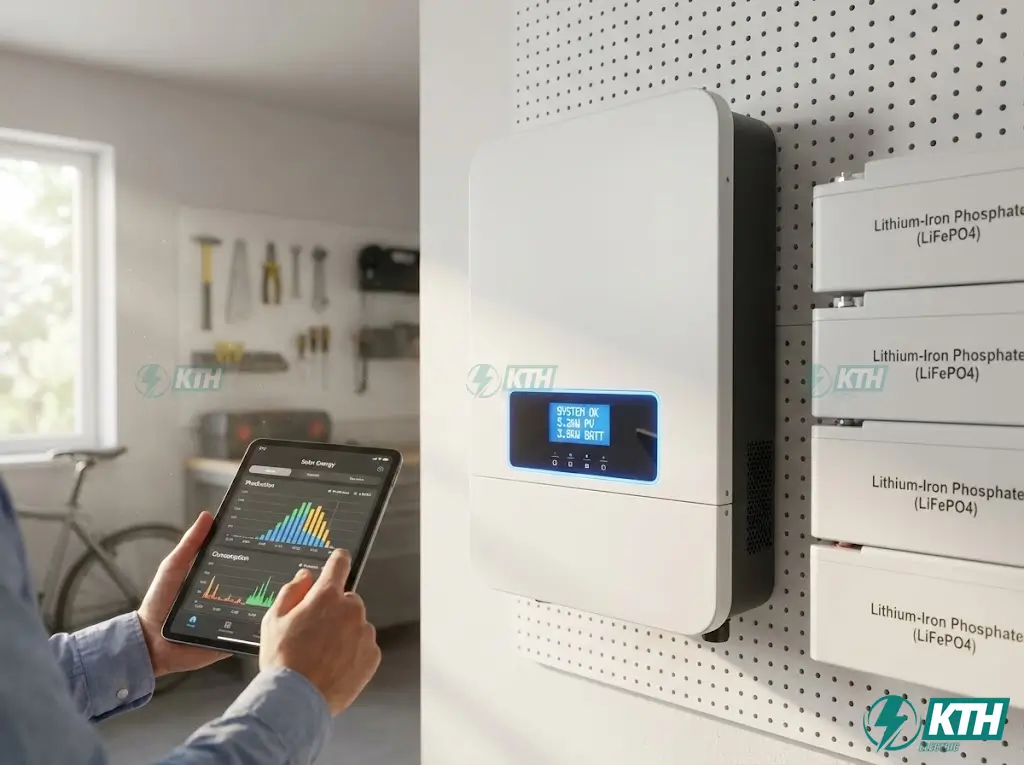
With the reduction in Feed-in-Tariffs (selling power back to the grid), storage is becoming essential.
- Lithium-Iron Phosphate (LiFePO4): The safest and longest-lasting battery chemistry today.
- Hybrid Inverters: These manage inputs from both the solar panels and the battery, automatically switching to battery power during a blackout.
Electrical Safety Gear
This is non-negotiable.
- DC Breakers & Fuse Holders: To protect against overcurrent. We often recommend High Rupturing Capacity (HRC) fuses for added safety.
- Surge Protection Devices (SPD): Vital in Vietnam to protect the expensive inverter from lightning strikes.
- Rapid Shutdown: A safety requirement that de-energizes the roof voltage instantly so firefighters can work safely in an emergency.
The Engineering Process: Sizing and Installation
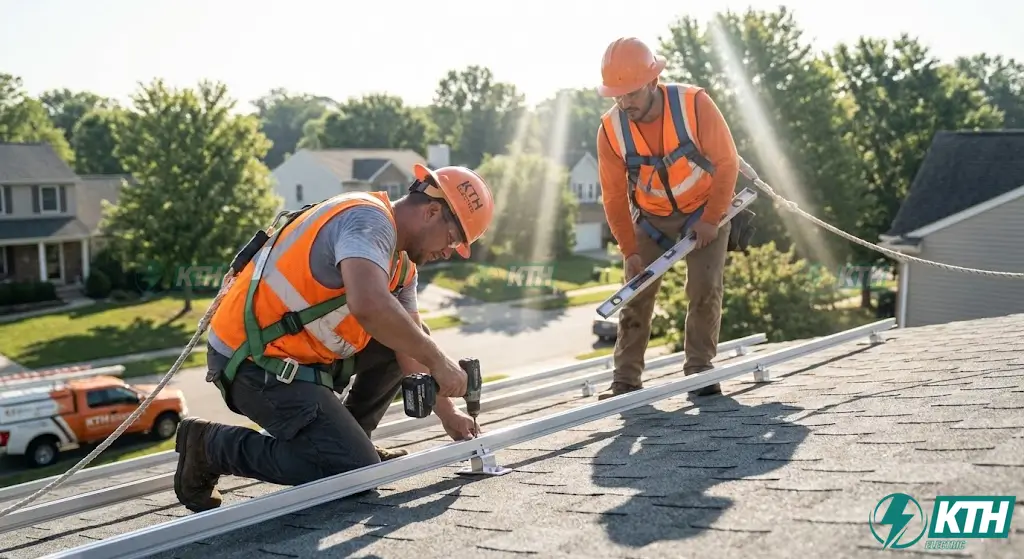
A professional installation follows a strict engineering protocol. At KTH Electric, we don’t guess; we calculate.
1. Site Survey and Shading Analysis
We use tools like a “Sun Pathfinder” or drone modeling to analyze your roof. We look for “hard shade” (chimneys, trees) that will kill production. If your roof faces South, you get 100% production. East/West faces get about 80-85%. North is generally avoided.
2. Calculating Energy Needs and System Sizing
We analyze your last 12 months of electricity bills. The goal is to offset your consumption, not massively overproduce (unless you plan to buy an EV).
Formula: Average Monthly kWh / 120 (Avg. Solar Hours) = System Size (kW).
3. Step-by-Step Installation Procedure
- Safety Setup: Harnesses and lifelines for the crew.
- Layout & Marking: Chalk lines on the roof to locate rafters.
- Racking Install: Drilling pilots, injecting sealant, and securing mounts.
- Wiring: Running DC conduit and grounding copper wire. Proper wire size for breakers is critical here to prevent voltage drop.
- Paneling: Clamping the panels to the rails.
- Inverter Hang: Mounting the inverter near the main distribution board.
- Commissioning: Turning it on and connecting to Wi-Fi for monitoring.
4. Grid Connection and Bi-directional Meter Setup
This is the bureaucratic part. We assist in filing the paperwork with the local utility (EVN) to install a Bi-directional Meter. This meter spins forward when you buy power and backward (digitally recording export) when you send surplus solar energy to the grid.
Maintenance and Troubleshooting
One of the best features of solar is low maintenance, but “low” does not mean “no.”
Cleaning Schedule and Best Practices
Dust, bird droppings, and urban pollution can reduce efficiency by 5-15%.
- Frequency: In Vietnam, cleaning is recommended every 3-4 months, or after the dry season.
- Method: Use de-ionized water and a soft brush. Never use abrasive soaps or high-pressure washers, which can damage the anti-reflective coating or force water into the seals.
Monitoring System Performance via Apps
Modern inverters come with smartphone apps. You can see:
- Real-time production (kW).
- Total daily energy (kWh).
- Historical data comparisons.
Pro Tip: If you see a sudden drop in production on a clear day, check your app. It might alert you to a tripped breaker or a ground fault.
Conclusion and Expert Recommendations
Solar energy is no longer a futuristic concept; it is a mature, reliable technology that offers one of the safest financial returns available today. Whether you want to secure your home against rising electricity prices, increase your property value, or contribute to a cleaner planet, the math makes sense.
Is Solar Power Right for Your Home?
Yes, if: You have a sunny roof (South, East, or West), high electricity bills, and plan to stay in your home for at least 5 years.
Maybe not, if: Your roof is heavily shaded by tall buildings, requires immediate replacement (fix the roof first!), or you are renting.
Checklist for Choosing a Reputable Installer
Don’t get burned by “fly-by-night” companies. Ensure your installer offers:
- License: Valid electrical contractor license.
- Equipment: Tier 1 panels and recognized inverter brands.
- Warranty: Clearly defined workmanship warranty (separate from the equipment warranty).
- Support: A local service team (like KTH Electric) that answers the phone when things go wrong.
Ready to stop renting your power and start owning it?
Contact KTH Electric Co., Ltd. today for a free, engineer-grade site assessment
US Hotline: 1 (336) 341-0068 | VN Hotline: 0968.27.11.99 | Email: kthelectric.com@gmail.com
Frequently Asked Questions (FAQs)
How long do solar panels actually last?
Solar panels are incredibly durable. While the standard performance warranty is 25 to 30 years, the panels don’t just stop working after that date. They simply degrade slightly (about 0.5% per year). A 30-year-old panel will likely still produce about 80% of its original power.
Do solar panels work on cloudy days or during the rainy season?
Yes, but with reduced output. Solar panels work on light, not heat. Even on a cloudy day, visible light penetrates the clouds. You can expect 10-25% of normal production during heavy overcast. This is why looking at “annual averages” is more important than daily fluctuations.
Can I run my air conditioner solely on solar power?
Technically, yes, but with a catch. An AC unit has a huge “startup surge.” A 5kW system can easily run a standard AC unit while the sun is shining. However, if a cloud passes over, the production drops, and the grid fills the gap instantly. To run AC solely on solar (off-grid), you would need a large battery bank to handle the surges and cloudy intervals.
What happens during a power outage?
This is the biggest misconception. Standard grid-tied solar systems will shut down during a blackout. This is a safety feature called “anti-islanding” to protect utility workers fixing the lines from being electrocuted by your panels. If you want power during a blackout, you must install a hybrid inverter with a backup battery.

REVIEWED BY:
DR. KHUONG NGUYEN-VINH
✓ Verified Expert
Dr. Khuong Nguyen-Vinh is a Lecturer in Electronic & Computer Systems Engineering at RMIT University Vietnam, dedicated to bridging the gap between advanced theory and practical energy solutions.
With a Ph.D. in Electrical Power Engineering from VSB – Technical University of Ostrava, his research focuses on intelligent control systems for renewable energy, including AI-driven fault detection for solar panels and optimized MPPT algorithms.
💡
Expert Commitment:
“A committed educator, Dr. Khuong mentors the next generation of engineers in power electronics, embedded systems, and sustainable technology integration for Industry 4.0.”
Discover more from KTH Electric Co., Ltd.
Subscribe to get the latest posts sent to your email.