
How to Wire a 50A – 250V Receptacle (NEMA 6-50 & 14-50): The Ultimate Guide [NEC 2023 Compliant]
⚡ Executive Summary
To wire a 50A – 250V circuit, strictly use #6 AWG Copper wire, a Double-Pole 50A Breaker, and the correct receptacle type. For NEMA 6-50 (Welders), connect two Hots to X/Y and Ground to G. For NEMA 14-50 (Ranges/EVs), add a Neutral wire to W. Always adhere to NEC 2023 safety standards.
To wire a 50A – 250V circuit, you generally need #6 AWG Copper wire (or #4 AWG Aluminum), a Double-Pole 50A Breaker, and the correct receptacle. For a NEMA 6-50 (Welders/some EVs), you connect two Hots to X and Y, and Ground to G. For a NEMA 14-50 (Ranges/RVs/Newer EVs), you add a Neutral wire to the W terminal.
🚨
CRITICAL SAFETY WARNING
Electricity kills. Always de-energize the main panel and perform a “Lockout/Tagout” before starting. If you are unsure about load calculations or local codes, hire a licensed professional for a full electrical system assessment.
1. NEMA 6-50 vs. NEMA 14-50: Which Do You Need?
💡 Quick Answer: Use NEMA 6-50 (3-wire) for dedicated welders. Use NEMA 14-50 (4-wire) for modern EV chargers and electric ranges to ensure future compatibility.
Before stripping a single wire, you must identify the correct receptacle. Understanding the difference between a socket vs outlet vs receptacle is the most common DIY mistake.
| Feature | NEMA 6-50R | NEMA 14-50R |
|---|---|---|
| Wires Required | 3 Wires: Hot, Hot, Ground | 4 Wires: Hot, Hot, Neutral, Ground |
| Voltage | 250V Only | 125V / 250V Hybrid |
| Common Uses | Welders, Plasma Cutters, Older EV Chargers | Electric Ranges, RVs, Modern EV Chargers (Tesla) |
| Cable Type | 6/2 NM-B or 6/2 MC | 6/3 NM-B or 6/3 MC |
2. Tools & Materials List
💡 Quick Answer: You strictly need #6 AWG Copper Wire (for 55A capacity), a 50A Double-Pole Breaker, and a Deep 2-Gang Box.
Failure to use the right materials is a direct violation of the NEC (National Electrical Code).
Materials
- ✓Wire/Conductor: Best Option is #6 AWG Copper (Rated 55A @ 60°C).
Alternative: #4 AWG Aluminum (Allowed, but requires anti-oxidant paste. Not recommended for EV charging).
- ✓Cable Type:
• For NEMA 6-50: 6/2 WG (Black, White*, Bare). *White must be re-marked as Hot.
• For NEMA 14-50: 6/3 WG (Black, Red, White, Bare).
- ✓
Breaker: 50A Double-Pole Circuit Breaker (Must match your panel brand).
- ✓
Box: 2-Gang Box (Deep). Never use a 1-gang box; it is too shallow for #6 wire.
Essential Tools
Voltage Tester / Multimeter
Wire Strippers
Torque Screwdriver
Optional: For professional electricians, keeping updated with the top 7 essential books for electricians is highly recommended to stay compliant with new codes.
3. Step-by-Step Wiring Guide: NEMA 6-50 (3-Wire System)
💡 Quick Answer: Connect Green to Ground, Black to Hot X, and White (re-marked) to Hot Y. Torque screws to 30 lb-in to prevent fire hazards.
Target Application: Welders, Workshop Equipment.
Step 1: Safety & Preparation
Action: Flip the main breaker OFF and verify with a voltage tester.
- Turn Off Power: Flip the main breaker to OFF.
- Verify: Use your voltage tester to ensure the panel is dead.
- Run Cable: Route your #6/2 cable from the main panel to the receptacle box location.
Step 2: Prepare the Wires
- Strip Jacket: Remove the outer sheathing to expose the conductors inside.
- Strip Ends: Strip about 1 inch (or check the “strip gauge” on the back of the outlet) of insulation. Keep copper clean.
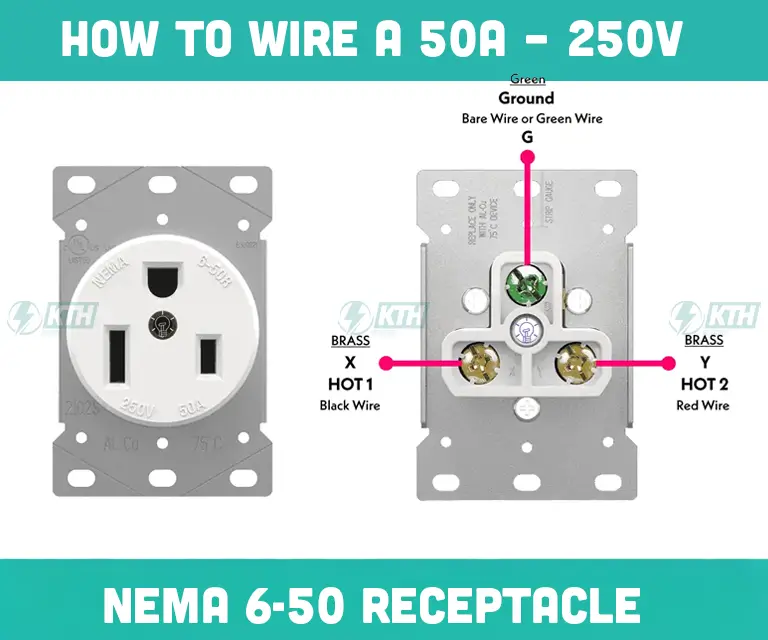
Step 3: Wiring the Receptacle (NEMA 6-50R)
1. Ground (G – Green Screw)
Connect the Bare Copper (or Green) wire here. This is your life-safety line.
2. Hot 1 (X – Brass Screw)
Connect the Black wire here.
3. Hot 2 (Y – Brass Screw)
Connect the White wire here.
Crucial: Wrap this white wire with Black/Red electrical tape to indicate it is “Hot”.
Torque It: Tighten screws to manufacturer specs (usually 30 lb-in / 3.4 N·m). Loose connections cause fires and may require a thermal scan electrical cabinet service later to detect hotspots.
Step 4: Connections at the Panel
- 🔌 Ground: Connect the Bare copper wire to the Ground Bus Bar.
- ⚡ Hots: Connect the Black and the Re-marked White wire to the two terminals on the 50A Double-Pole Breaker.
- 🔒 Snap in: Install the breaker into the bus bar.
4. Variation: Wiring a NEMA 14-50 (4-Wire System)
💡 Quick Answer: Requires 6/3 Cable. Connect the additional White wire to the W (Neutral) terminal.
Target Application: EV Chargers, Electric Ranges, RV Hookups.
If your device requires a neutral (or you want future-proofing), install a NEMA 14-50 using 6/3 Cable.
Wiring Configuration Checklist:
- Ground (G – Green): Connect Bare wire to Green screw.
- Neutral (W – Silver): Connect White wire to the Silver screw (labeled W).
- Hot 1 (X – Brass/Black): Connect Black wire to Brass screw X.
- Hot 2 (Y – Brass/Black): Connect Red wire to Brass screw Y.
Note: In the main panel, the White wire goes to the Neutral Bus Bar, and the Bare wire goes to the Ground Bus Bar. (In a sub-panel, keep these separated).
5. NEC 2023 Code Compliance & Safety
💡 Quick Answer: NEC 210.8 requires GFCI for Garages/Outdoors. Hardwire EV chargers to avoid “nuisance tripping” with GFCI breakers.
As a professional, I must highlight three areas where DIYers often fail inspections:
1. The GFCI Requirement (NEC 210.8 & 625.54)
Summary: Use GFCI breakers for plug-in outlets in garages. Hardwire if possible.
- Outdoor/Garage: If this outlet is in a garage, outdoors, or a damp location, NEC requires a GFCI Breaker.
- EV Charging: All receptacles installed for EV charging require GFCI protection for personnel.
- The Conflict: Some EV chargers have built-in GFCI monitors that “fight” with GFCI breakers, causing nuisance tripping.Solution: Hardwire the EV charger (remove the plug) to bypass the need for a GFCI receptacle breaker, provided the unit has internal protection.
2. The “Continuous Load” Rule (80% Rule)
Summary: Max load for 50A circuit is 40A if running >3 hours.
A 50A circuit can only handle 40A continuous load (3 hours or more).
- EV Charging: Set your car or charger to draw max 40A.
- Welding: Usually non-continuous, so full 50A bursts are acceptable. If you are confused about current ratings, check out our Ampere explained guide.
3. Aluminum vs. Copper
Recommendation: Always use Copper for EV chargers.
While #4 AWG Aluminum is cheaper, I rarely recommend it for receptacles subject to vibration or thermal cycling (like EV charging). Aluminum expands and contracts more than copper, leading to loose connections over time. Stick to #6 AWG Copper for peace of mind. For industrial setups, regular electrical system maintenance service is advised to check these connections.
6. FAQ: Expert Answers
💡 Quick Answer: No 120V loads allowed. Use 6/3 wire for NEMA 14-50. Check torque if tripping occurs.
Q: Can I use 6/2 wire for a NEMA 14-50?
A: No. That is dangerous and illegal. The NEMA 14-50 requires a neutral wire. 6/2 cable only has 2 insulated wires and a ground. You must use 6/3 cable.
Q: My breaker keeps tripping when I plug in my EV charger.
A: If you are using a GFCI breaker, it might be conflicting with the charger’s internal self-test. Or, your connections might be loose (generating heat). Check torque specs immediately.
Q: Can I install this on a 120V circuit?
A: Absolutely not. NEMA 6-50 and 14-50 are 240V configurations. Connecting them to 120V will damage equipment or simply not work. If you need to wire smaller 250V outlets, refer to our guides on how to wire NEMA 6-20 or how to wire NEMA 6-15 receptacle.